

Storytelling games are activities related to a story that help expand learning through stories with additional, game-based activities. They help boost children’s English language skills, but also children enjoy the process of learning through games.
Games are exciting, involve the whole family, and are a positive experience for children. From my personal experience of using games with my children and private ESL students, I have noticed how much children thrive with the interactive elements and rewards games provide them.
Let’s take a look at why you should consider using storytelling games, the benefits, and 15 interactive storytelling games for children learning the English language.
Table of Contents
- Understanding the Needs of English Language Learners
- Exploring Interactive Storytelling Games
- 15 Storytelling Games for Children
- Practical Tips for Using Storytelling Games At Home

Explore the FREE Resource Library
Fun, educational activities for children aged 3–8 completely free!
Discover a growing collection of printable games, vocabulary activities, crafts, and themed resources designed to help children build language and literacy skills through stories, play, and creativity.
Spend less time searching for activities and more time learning, playing, and creating together.
Understanding the Needs of English Language Learners
Children are indeed natural learners. They’re inquisitive about the world around them and always ask questions to find out more. But, when formal learning is placed in front of them, what often happens is that they lose interest and lack an inner self-drive to focus on the task in front of them.
When we place formal learning in front of our children e.g. textbooks with workbooks to complete, we take away our children’s freedom in how they learn and what they want to learn about. They then become bored, distracted, and lack motivation to continue the task they’ve been given. These problems are no different when it comes to language learning.
To make learning English more child-friendly and relevant to your children, it is important to meet them at their level. What do children enjoy? What catches their attention and retains their focus? What motivates them to learn?
Generally speaking, children learn best when:
- they are having fun,
- they are interested in what they are learning about,
- the learning is relatable in some way to them,
- and they have a positive experience e.g. they receive praise for their efforts.
Storytelling, multisensory learning, and play-based activities each meet these requirements and ensure your children enjoy their experience of learning English.
An excellent way to bring these activities together is through storytelling games.

Exploring Interactive Storytelling Games
Storytelling games for children offer a fun and exciting way to learn English. They are engaging, motivating, and inclusive no matter your child’s English level.
What makes storytelling games extra effective is that they incorporate a vast range of skills children need to develop not only for language learning, but also for emotional, social, and cognitive development. These skills include:
- Language Acquisition: Storytelling games provide opportunities for children to acquire and expand their vocabulary, learn new phrases, and grasp grammar concepts in context.
- Creativity: Engaging in storytelling encourages children to use their imagination to create characters, settings, and plots, fostering creativity and originality.
- Communication Skills: Through storytelling games, children practice verbal communication as they share their ideas, narrate stories, and collaborate with others.
- Listening Skills: Active listening is essential in storytelling games, as children must pay attention to others’ contributions, follow the storyline, and respond appropriately.
- Critical Thinking: they prompt children to think critically as they make decisions about plot development, character actions, and story outcomes.
- Problem-Solving: Children often encounter obstacles or challenges in storytelling games, requiring them to problem-solve and find creative solutions within the narrative.
- Social Skills: Storytelling games promote social interaction and cooperation as children collaborate with peers, negotiate ideas, and take turns sharing their contributions.
- Confidence Building: Participating in storytelling games helps children build confidence in expressing themselves verbally, sharing their ideas, and contributing to group activities.
- Emotional Intelligence: Storytelling often involves exploring emotions, empathy, and interpersonal relationships, allowing children to develop emotional intelligence and empathy.
- Cultural Awareness: they may incorporate diverse characters, settings, and cultural references, fostering cultural awareness and appreciation among children.
- Memory Skills: Remembering characters, plot details, and story sequences in storytelling games exercises children’s memory and recall abilities.
- Narrative Structure: Engaging in storytelling games introduces children to the structure of narratives, including beginnings, middles, and ends, as well as character development and plot progression.
- Attention Span: they require children to sustain attention and focus for extended periods, enhancing their attention span and concentration skills.
- Literacy Skills: Storytelling games can lay the foundation for literacy development by encouraging a love for storytelling, reading, and writing.
- Cultural and Historical Knowledge: they may incorporate elements of culture, history, and folklore, providing children with opportunities to learn about different traditions and time periods.
Related Post: The Power of Storytelling: How Stories Can Enhance English Language Learning

15 Storytelling Games for Children
Here is a list of 15 storytelling games that you can complete with your children at home to aid their English language development whilst enjoying the process. A good idea is to use a range of these games with a different goal in mind for your children to achieve. This ensures that, whilst your children enjoy the activity, you feel reassured that they are still learning and progressing with their English language.
1. Story Cubes
These fun paper cubes are easy to make and design at home. Using the cube template from my storytelling tools pack, ask your children to design pictures within each square. These could be open-ended, helping to encourage your children to use their imagination. Or they could be themed on a specific story to help retell the story, or by giving them a specific story prompt e.g. a princess and a fox become friends and travel together.
Once your children have finished designing each square, cut the outside and glue the sides together. This builds your story cube.
You can then take turns to roll the story cube and make a story or retell a story together. Story cubes help encourage creativity, vocabulary expansion, self-expression, imagination, and retelling skills.
Explore the FREE Resource Library
Fun, educational activities for children aged 3–8 completely free!
Discover a growing collection of printable games, vocabulary activities, crafts, and themed resources designed to help children build language and literacy skills through stories, play, and creativity.
Spend less time searching for activities and more time learning, playing, and creating together.
2. Tell-A-Story Cards
Similar to Story Cubes, these cards feature different scenes or characters that children can use to build their own stories.
These story cards are especially good for children who need support to build their imagination and creativity. As they provide a prompt, it means your children don’t have to start from scratch to create an idea. They already have a foundation to build upon which can aid confidence building.
3. Once Upon a Time
This is a pre-designed card-based game where players collaboratively create a fairy tale using story prompts. This game fosters storytelling skills and language development.
It’s perfect as an activity for families to do together, helping you bond over learning a new language and motivating your children with positive encouragement.
As a game-based activity also, this is good for children who struggle with formal learning activities as it focuses on hands-on, play-based learning instead.
4. Story Starters
Unlike number 2, these story starters offer a specific open-ended prompt to begin a story. The prompt helps provide children with a starting point while still allowing creativity and idea generation to take place.
The concept of story starters is for people to work together as a team to create a story using the given prompt.
Each family member takes turns adding to the story, practising language skills along the way.
As a collaborative storytelling session, it takes the pressure away from your children focusing more on working as a team to create a new story.

5. Word Association Games
This game is popular with children of all ages and one I use a lot as a warm-up in my online classes.
Starting with a word, you then take turns to share another word you would associate with the first word. For example, if the first word was the beach, you might say things such as sand, sea, palm trees, sandcastle, umbrella, boat, and so on.
The point of this game isn’t necessarily to create a story, but to help build vocabulary and encourage word linking.
If your children find this on the easier side, you could do what I do with my students. I set a timer for them to list as many words as possible until the timer runs out. Then, they need to create sentences using as many of those words as possible. This helps add an extra competitive and challenging layer, whilst continuing to build their vocabulary range, sentence structure, and grammar.
6. Mad Libs
Mad Libs is a great game, especially for children with a sense of humour.
You have a short story with fill-in-the-blank gaps. Each gap is a different part of speech e.g. nouns, adjectives, verbs, etc. You provide your children with the list of word types they need to come up with. For example, maybe there needs to be a noun, 2 adjectives, and 3 verbs. You could also give a theme e.g. school, at the park, or food for example.
Once your children have their completed list of words, you can then use them to fill in the gaps. The short story is then read aloud for everyone to hear.
Quite often, this game creates hilarious and nonsensical tales that children just love.
Mad Libs itself is beneficial as it helps reinforce grammar concepts, vocabulary, listening skills, and comprehension.
7. Charades
Charades is a great storytelling game where each person takes turns acting out words or phrases. These could relate to parts of a story, book titles, or characters.
Incorporating actions and physical movement can be excellent for children with ADHD, who prefer to learn kinesthetically, or simply for children who love drama-based activities.
Through charades, children can improve their vocabulary, observation, and communication skills. Act out words or phrases without speaking while family members guess what you’re trying to convey.

8. I Spy with Picture Books
Similar to the classic game of I Spy, but instead of looking at what’s around you, you use picture books.
Choose a picture book at home to look at with your children. As you read together, pause to look at the illustrations. Take turns to give clues for everyone else to guess and find.
This activity is great for encouraging children to interact with the words and pictures within a book. It helps with language development, comprehension, and listening skills.
9. Consequences
This paper-based game is so much fun and always ends in laughter.
A piece of paper is folded over, and only one section is shown. On the piece of paper has written elements of a story to be completed e.g. once upon a time ……., who visited a ……., and played ……
Players take turns to unfold one section to complete. At the end of the game, the whole piece of paper is unfolded and the story is read aloud.
Consequences help promote creative writing, problem-solving, and collaborative thinking.
This can also be adjusted to create elements of a story such as characters, settings, and plots.
10. Storytelling Apps
Storytelling apps are incredibly interactive, incorporating not only English language skills and imagination but also digital literacy skills and role-playing.
Often, storytelling apps are very open-ended, providing options and choices for your children to select from to create their own worlds. From character design to backgrounds, settings, and more, these apps are engaging and particularly effective for children who struggle with formal learning methods e.g. workbooks and require something with interactive elements.
Here are 5 storytelling apps to try at home with your kids:
- Toca Life World: Build a Story (Google Play / Apple App Store)
- Sago Mini World: Kids Games (Google Play / Apple App Store)
- Imagistory – Creative Storytelling App for Kids 4+ (Apple App Store only)
- Toontastic 3D (Google Play only)
- PicaBook: Picture Book Creator (Google Play / Apple App Store)
Explore the FREE Resource Library
Fun, educational activities for children aged 3–8 completely free!
Discover a growing collection of printable games, vocabulary activities, crafts, and themed resources designed to help children build language and literacy skills through stories, play, and creativity.
Spend less time searching for activities and more time learning, playing, and creating together.
11. DIY Storytelling Kits
Create your own storytelling kits at home with your kids that include designing and making props and costumes. Along with some written story prompts, these kids can be a fun way to bring stories to life. Either encourage your children to create and role-play their own story from the prompts, or, to act out parts of a story you have read together.
Role-play and dress-up prompt imaginative play, language exploration, creativity, and problem-solving skills.
12. Digital Storytelling Platforms
Websites such as Storybird or StoryJumper enable your child to create a digital story that can then be purchased as a hard copy book. With tools such as audio recording and characters to choose from, these websites help give your children a helping hand to start forming their very own story.
Sites such as these are motivating for young people as they can see the opportunity to share their work digitally with other families and/or see their story as a physical copy.
With tools available to choose from, they already offer a foundation for your children to create a story. These websites help build digital literacy skills, cognitive thinking, language development, creativity and imagination.
13. Role-Playing Board Games
Board games are fun for the whole family to get involved in and are excellent to help take a break from screentime.
Role-playing games often involve each player in selecting or making a character. Depending on the game, you might be given story prompts, missions, or props to use as the game progresses.
A classic well-known role-playing board game is Dungeons and Dragons. However, depending on your children, this game might be a little too old or advanced for them. Here are some alternatives to D&D for kids:
- Hero Kids
- No Thank You, Evil!
- Amazing Tales
- The Adventure Guild
- My Little Pony: Tales of Equestria
- Mouse Guard: Role-playing Game
Role-playing games are excellent for practising language and developing vocabulary. But they also help build confidence, social and emotional skills, critical thinking, and problem-solving.
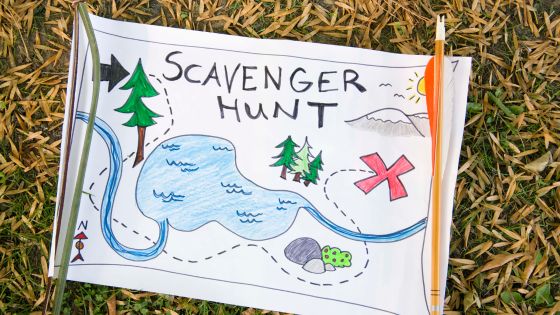
14. Scavenger Hunt Stories
Scavenger hunts are a firm favourite in my house. Both of my children actively ask me to create a scavenger hunt that they can complete. Although learning takes place, they don’t see it as a chore and often forget that the focus is on learning, as they are fully engaged in the fun activity.
Scavenger hunts do not have to be complicated. The premise of a scavenger hunt is to provide clues for your children to solve and find the next clue until they complete the whole activity.
For language learning, you could create a scavenger hunt focused on
- phonics e.g. drawing a picture of an item on one side of a piece of paper with a different word for them to read and find the next clue. For example, on one piece of paper, I have drawn a hen with the word dog on the other side. They read dog to find the next picture, which will have the word cat to find.
- Learning non-fiction facts. For this, I often match another activity such as a crossword puzzle. For each word of the crossword, they are given a written clue to find the answer around the house. When they find the answer, they can write it in their crossword puzzle.
- Retelling a story. These clues might be attached to props from a story we have read together. Each clue would ask comprehension questions that relate to the next prop. For example, if we were retelling The Little Red Hen. I might have a picture of wheat, some flour, seeds, and bread. The props would be in sequential order to help retell the story. Starting with the seeds, the clue may ask a question about who plants the seeds. What do the seeds grow into, where do you plant seeds?
Scavenger hunts help to promote reading skills, vocabulary expansion, comprehension, problem-solving, and collaboration.
15. Pictionary
Pictionary is a particularly good storytelling game for children who enjoy drawing. Split into teams, each team selects a card from a list of prompts. They must draw this prompt for the rest of their team to guess. The team must guess before the time runs out. Whoever has the most points at the end wins the game.
To make this into a storytelling game, the prompt cards used could relate to different book titles, characters, or even story props. Here are some examples:
- The Gingerbread Man: focus on different characters that chase him in the story
- Cinderella: create prompts relating to props in the story e.g. pumpkin, shoe, mouse, clock, etc
- Winnie the Pooh: include different settings within the woods e.g. Owl’s tree, Rabbit’s hole, Eeyore’s stick house, etc.
Pictionary is incredibly adaptable, ensuring that it is accessible to all children,n no matter their English ability or age. Pictionary helps children build cognitive skills, vocabulary expansion, social interaction, and communication skills.
Explore the FREE Resource Library
Fun, educational activities for children aged 3–8 completely free!
Discover a growing collection of printable games, vocabulary activities, crafts, and themed resources designed to help children build language and literacy skills through stories, play, and creativity.
Spend less time searching for activities and more time learning, playing, and creating together.
Practical Tips for Using Storytelling Games at Home
Learning happens best when our children are having fun and can relate to the material in front of them. Storytelling games provide this opportunity. They are adaptable and creative, incorporate hands-on activities, and are incredibly enjoyable for children.
However, even with games, children can lose interest, become disengaged, and tire easily. To retain their attention and motivation to join in, it is best to rotate your planned activities. Try to include using storytelling games regularly, perhaps alongside your reading daily routine, but mix and match which games you will play.
It is also a good idea to use storytelling games interlinked with the stories you read to help extend learning opportunities surrounding the text.
For example, if you are reading Peter Rabbit, your schedule might look like this:
- Monday: discuss the pictures in the book. Play I Spy to cover the new vocabulary
- Tuesday: read the story together. Build a story cube and help your children retell the story with the cube
- Wednesday: Look at the characters. Play charades to help practice language for each character in the story
- Thursday: Focus on the settings. Play word association to help your children make links with different elements within a setting e.g. farm – vegetables – shed – scarecrow – farmer
- Friday: talk about any problems and solutions the characters face. Create a scavenger hunt that helps your children work through comprehension questions in a sequential order.
Storytelling games for children offer an excellent opportunity to learn and develop English language skills. Due to their hands-on, multisensory, and collaborative approach, they help retain your children’s attention and motivate them to participate.
Using storytelling games alone, however, will not be enough to improve your children’s English ability. They are best utilized alongside other activities such as daily conversation practice, storytelling sessions, and creative writing activities. This enables your children to practice and develop each core English language skill (speaking, listening, reading, and writing).
Explore the FREE Resource Library
Fun, educational activities for children aged 3–8 completely free!
Discover a growing collection of printable games, vocabulary activities, crafts, and themed resources designed to help children build language and literacy skills through stories, play, and creativity.
Spend less time searching for activities and more time learning, playing, and creating together.
Related Posts
- The Power of Storytelling: How Stories Can Enhance English Language Learning
- Creating a Storytelling Routine: Incorporating English into Your Family’s Daily Life
- Bilingual Storytime: Tips for Using Dual-Language Books to Learn English
- How To Use Fairy Tales To Teach Your Kids English
- Engaging Your Child’s Imagination: Story-Based English Learning Activities

