

For children learning English as a second language, multiple resources come in handy to retain their attention and focus. But subscribing to different apps, memberships, or purchasing books and workbooks quickly adds up.
Luckily there are lots of free and affordable websites at your fingertips to help your children learn English vocabulary. By using these resources, you can turn screen time into an educational experience that broadens your child’s language skills.
From engaging games to interactive lessons, these websites cater to different age ranges, ensuring that there’s something suitable for every stage of development. You’ll find options for young learners just starting out, as well as more advanced resources for older children. Some sites are free, while others offer premium features for a small fee, giving you plenty of flexibility to choose what works best for your family.
Discover top websites to learn English vocabulary like Starfall, ABCya, Kids Wordsmyth, and many more. Each platform has its unique set of features and benefits, making it easier for you to support your child’s journey towards a richer English vocabulary.
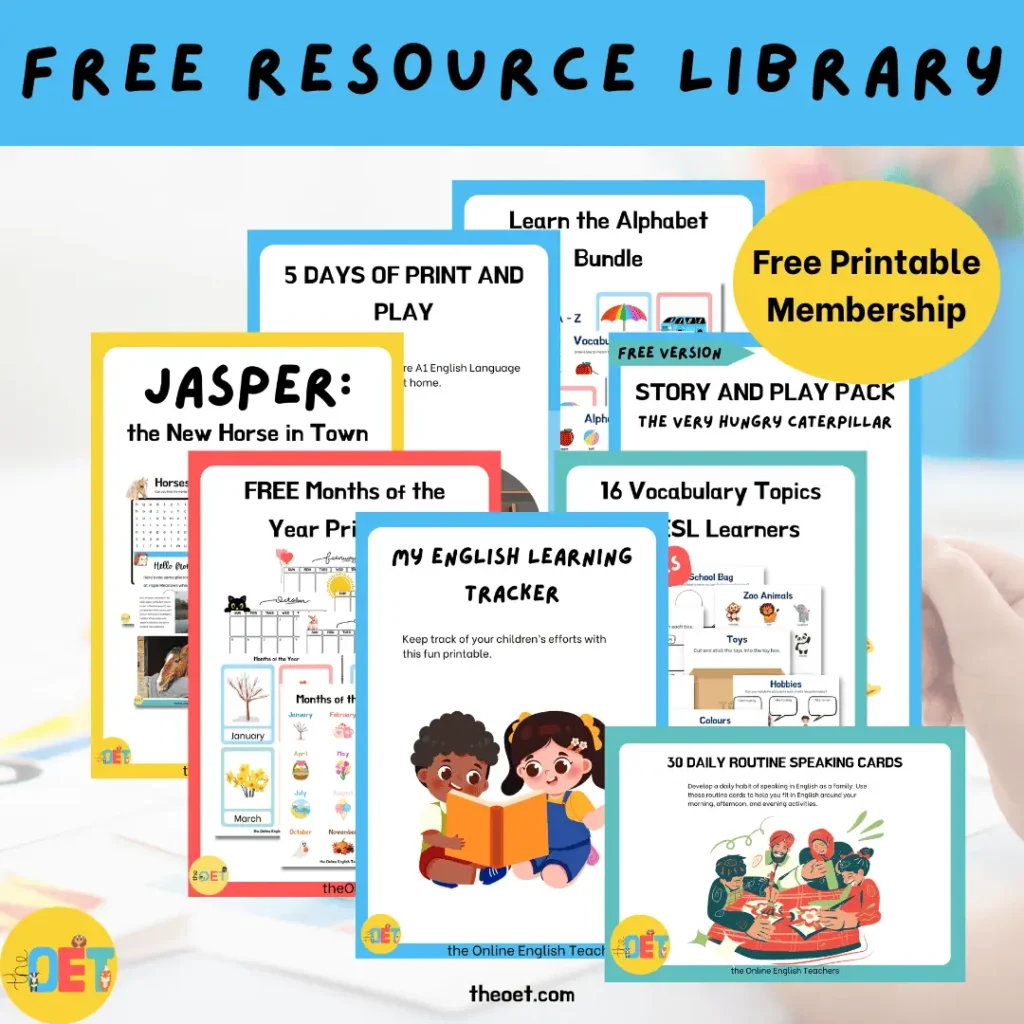
Join the FREE Resource Library
Looking for FREE quality printables, templates, and guides to help you teach your kids ESL at home?
Join theOET’s FREE Membership and gain access to 10s of resources designed by a qualified teacher to help your family learn English at home.
New resources are added every month. Save time, money, and stress with pre-made educational printables and guides.
Vocabulary Websites for 3-6-Year-Olds
When it comes to expanding your child’s English vocabulary in a fun and engaging way, there are several websites specifically designed for 3-6-year-olds that can make learning an enjoyable experience. These websites offer a variety of interactive activities and resources to help young learners enhance their vocabulary skills. Ideal websites for 3-6-year-olds should include:
- Age-Appropriate Vocabulary Games
Engaging in vocabulary games is an excellent way to introduce new words and concepts to young children. When tailored to the cognitive levels of 3-6-year-olds, these games can be both educational and entertaining. By incorporating elements of play and competition, children are more likely to retain and recall the words they learn. The benefits of gamified learning in enhancing children’s vocabulary acquisition include improved memory retention, increased engagement, and the development of problem-solving skills.
- Interactive Storybook Websites
Interactive storybook websites offer a unique way for young children to engage with English vocabulary in a fun and immersive manner. These platforms provide interactive stories that not only entertain but also educate children on new words and their meanings. Through colourful illustrations, audio cues, and interactive elements, children can have a hands-on learning experience that stimulates their curiosity and enhances their language skills.
- Limited Distractions
At this young age, children can become distracted incredibly easily. Try to utilise websites that aren’t too busy, with simpler layouts, easy-to-read fonts, and bold graphics. This will help your children navigate websites and focus on the task at hand.
Recommended Websites for 3-6-Year-Olds:
Starfall
Starfall is an educational website offering reading and math activities for children from pre-K to fifth grade. It provides interactive stories, games, and songs that aim to develop literacy and numeracy skills. Children learning English can learn their ABCs, early reading skills, and listen to nursery rhymes, and stories.
- Summary: Starfall offers a wide range of interactive activities, games, and songs to help children learn English vocabulary in an engaging way.
- Pros: Colourful and interactive content, suitable for young learners.
- Cons: Limited free content and premium features require a subscription.
ABCya
ABCya offers educational games for children from pre-K to sixth grade, covering subjects like math, reading, and typing. The games are designed to make learning fun and interactive with lots of gamification and interactive elements.
- Summary: ABCya provides educational games and activities covering various subjects, including vocabulary building.
- Pros: Extensive selection of games, aligns with educational standards.
- Cons: Free version includes ads and the premium membership offers an ad-free experience.
Kids Wordsmyth
This website offers a wide range of vocabulary-building exercises and games that cater to the specific needs of young learners. Children can engage with word puzzles, memory games, and interactive quizzes that help reinforce their understanding of new words.
- Summary: Kids Wordsmyth offers animated videos with English vocabulary lessons designed to engage young learners.
- Pros: Visual learning aids to enhance understanding.
- Cons: Limited selection of videos. Some of the content is free but for full access, a paid subscription is required.
These websites cater to the specific needs and interests of 3-6-year-olds, providing a blend of entertainment and education to support their English language learning journey. By exploring these platforms, you can create a stimulating environment for your child to explore and expand their vocabulary in an enjoyable way.

Vocabulary Websites for 5-8-Year-Olds
When looking for websites to help your 5-8-year-olds expand their English vocabulary, interactive and engaging platforms are key. These websites offer a fun and effective way for children to enhance their language skills while promoting a love for learning.
These websites should include:
- Increased Independence
At this age, children are very quick at navigating websites and using digital literacy skills. The websites you consider using should provide opportunities for your children to access tools independently e.g. selecting their own activities.
- Multimedia
At 5-8 years old, your children will still struggle to focus and retain their attention for longer periods of time. To support this, select websites that provide different media such as audio, animated videos, and digital games.
- Level Appropriate
Though 5-8-year-old native English speakers may have a more varied vocabulary range and be reading a wider range of stories outside of picture books, language learners won’t be at the same level.
Therefore, it is important to take your children’s English language level into account rather than their age. Consider using a range of vocabulary websites that aren’t just designed with your children’s age in mind, but also their current English ability. Using resources that are too difficult for your children will deter them from wanting to learn English. Perhaps use a combination of websites for 3-6 year olds and 5-8 year olds.
Recommended Websites for 5-8-Year-Olds:
Vocabulary Spelling City
Vocabulary Spelling City is a website and app offering vocabulary and spelling practice through games, tests, and activities. It aims to improve literacy skills for students of all ages.
- Summary: Offers vocabulary lists, spelling practice, and games based on grade level.
- Pros: Customizable word lists, progress tracking, and printable worksheets.
- Cons: Some features require a paid membership (from $29.99/year).
Freerice
Freerice is an online platform where users can improve their vocabulary while contributing to global hunger relief. For every correct answer in their vocabulary quizzes, the site donates rice through the World Food Programme.
- Summary: A vocabulary-building game where correct answers donate rice to the World Food Programme.
- Pros: Engaging gameplay, covers a wide range of topics, and supports a good cause.
- Cons: Ads on the free version, limited customisation options.
Mrs Wordsmith
Mrs Wordsmith provides interactive grammar and vocabulary lessons that are engaging and informative for 5-8-year-olds. The platform uses colourful illustrations and relatable examples to make learning fun and effective.
- Summary: Website and app that gamifies learning vocabulary and spellings.
- Pros: Engaging and visually appealing content.
- Cons: Limited free resources and focus on subscription-based pricing.
By incorporating these websites into your child’s learning routine, you can make English vocabulary expansion an enjoyable and enriching experience for your 5-8-year-olds.

Vocabulary Websites for 9-12-Year-Olds
When looking for websites to learn English vocabulary for 9-12-year-olds, there are several platforms that offer engaging and educational content tailored to older children’s learning needs. These websites provide a mix of free and paid options to help children in this age group learn and grow their vocabulary in a fun and interactive way.
Join the FREE Resource Library
Looking for FREE quality printables, templates, and guides to help you teach your kids ESL at home?
Join theOET’s FREE Membership and gain access to 10s of resources designed by a qualified teacher to help your family learn English at home.
New resources are added every month. Save time, money, and stress with pre-made educational printables and guides.
Here are some things to consider when selecting a website for your 9-12-year-olds:
- Age Appropriate
As your children get older, they really do not appreciate content designed for younger children. Hence, even if your children are studying English at a beginner level, it is important not to use websites designed for 3-6-year-olds. Your children won’t appreciate it and will become bored very, very quickly.
Make sure that the websites you use don’t have childish content but suit your children’s current language level.
- Challenging Content
Your children will most likely have had years of experience using digital tools. Make sure to challenge them with different word games, spellings, dictionaries, and interactive games.
Recommended Websites for 9-12-Year-Olds:
Vocabulary.com
Vocabulary.com is a comprehensive website that combines grammar and vocabulary lessons to support holistic English language learning for older children. It offers interactive quizzes, word lists, and educational resources to enhance vocabulary skills.
- Summary: Educational activities suitable for older children to expand their vocabulary whilst incorporating grammar.
- Pros: Detailed explanations and in-depth learning resources.
- Cons: This may require parental guidance for younger users, and though free, it has premium features that cost.
Quizlet
Quizlet offers study tools like flashcards, quizzes, and games for various subjects and educational levels. Users can create their own study sets or use ones shared by others.
- Summary: Quizlet provides versatile study tools, including flashcards and quizzes for a wide range of subjects.
- Pros: User-generated content and diverse study modes.
- Cons: The quality of user-generated content can vary and there is a premium subscription for additional features.
Merriam-Webster’s Word Central
Merriam-Webster’s Word Central is designed for young learners to explore vocabulary through engaging games and a user-friendly dictionary. The site also features a daily buzzword to expand students’ vocabulary.
- Summary: Merriam-Webster’s Word Central offers vocabulary games and an accessible dictionary for children.
- Pros: Trusted dictionary resource, fun and educational games. Completely free to use.
- Cons: The interface may feel dated.
Flocabulary
Flocabulary uses educational hip-hop videos to teach a variety of subjects, including vocabulary, language arts, and history. The videos aim to engage students and improve retention through music and rhythm.
- Summary: Flocabulary provides educational hip-hop videos to teach various subjects and enhance student engagement.
- Pros: Engaging musical content, covers diverse subjects.
- Cons: Subscription required for full access.
By exploring these websites, you can provide your children with valuable resources to support their English language learning journey. From word puzzles to grammar lessons, these platforms offer a diverse range of activities to help older children expand their vocabulary and improve their language skills.

Mixed Age Group Websites
When you have children of varying ages who are all learning English, finding websites that cater to different age groups can be a game-changer in making learning fun and engaging for the whole family. These websites offer activities and challenges that are adaptable to different levels, allowing siblings with varying language abilities to learn together and support each other’s language development.
Multi-Level Vocabulary Games
Websites that offer multi-level vocabulary games are ideal for mixed-age group families. Platforms like ABCya and Mrs Wordsmith provide a range of interactive games that can be adjusted to different difficulty levels, making it possible for younger and older children to play and learn together. This not only fosters a sense of teamwork among siblings but also ensures that each child is challenged at their own level.
Family Vocabulary Challenges
Engaging in vocabulary challenges as a family can be a fun way to encourage everyone to expand their language skills. Websites like Vocabulary.com and Vocabulary Spelling City offer family-friendly challenges and activities that promote collaborative learning. By participating in these challenges together, siblings can motivate each other to excel and create a supportive learning environment within the family.
Incorporating these multi-level vocabulary games and family challenges into your English learning routine can not only make learning more enjoyable but also strengthen the bond between siblings as they navigate their language-learning journey together. These websites bring the whole family together in a shared learning experience, making English vocabulary acquisition a collaborative and enjoyable journey for all.
Tips on How to Use Educational Websites
Incorporating educational websites into your child’s routine can be a powerful tool for enhancing their English vocabulary. By creating structured learning routines, you can establish a consistent schedule that fosters effective vocabulary acquisition. Consider setting aside specific times each day dedicated to online vocabulary learning to make it a regular part of their routine.
Creating Structured Learning Routines
To integrate online vocabulary learning effectively, consider strategies like starting the day with a word of the day, incorporating vocabulary games during breaks, or even setting aside a specific time for online activities. By making it a consistent part of their day, children are more likely to engage and retain the new words they learn.
Reinforcing Online Learning
While online platforms are valuable for learning, it’s essential to balance screen time with off-screen activities. Encourage your child to practise using new words in everyday conversations or engage in vocabulary-building games offline. This reinforcement helps solidify their understanding and retention of the new vocabulary they acquire online.
Tracking and Celebrating Progress
To ensure your child stays motivated and engaged, consider tracking their vocabulary development. This could be as simple as keeping a log of new words learnt or setting mini milestones to celebrate their progress. By acknowledging their achievements, you can instil a sense of accomplishment and encourage them to continue learning.
By implementing these tips, you can effectively utilise educational websites to enhance your child’s English vocabulary skills and provide a fun and interactive learning experience. Helping children expand their vocabulary in an engaging manner sets a strong foundation for their language development.
Remember, consistency and positive reinforcement play a key role in your child’s learning journey. Embrace the digital age as a tool to support your child’s education and make the most of these online resources to boost their English vocabulary proficiency.
Utilising websites to learn English vocabulary is a powerful way to support your children’s language development at home. By exploring the recommended websites, you can tailor the learning experience to suit their age and proficiency levels.
For younger children aged 3-6, websites like Starfall and ABCya offer engaging and interactive activities that make learning fun. Starfall is particularly excellent for its colourful animations and phonics lessons, while ABCya combines play and education effectively.
Children aged 5-8 can benefit from Mrs Wordsmith and Freerice Mrs Worsmith stands out for its visually appealing resources, whilst Freerice includes giving back and connecting with the world whilst engaging in fun games.
For older children aged 9-12, Vocabulary.com and Flocabulary provide more advanced resources. Vocabulary.com offers personalised vocabulary practice, while Flocabulary uses music and videos to teach complex words, ensuring that learning remains engaging.
Explore these websites and actively engage with your child’s language development journey. By integrating these resources into their daily routine, you can significantly enhance their English vocabulary and create a more enriching learning environment.
Join the FREE Resource Library
Looking for FREE quality printables, templates, and guides to help you teach your kids ESL at home?
Join theOET’s FREE Membership and gain access to 10s of resources designed by a qualified teacher to help your family learn English at home.
New resources are added every month. Save time, money, and stress with pre-made educational printables and guides.
Related Posts
- Top Tips to Improve English Vocabulary For Your Kids
- 11 Engaging Vocabulary Activities For Kids To Learn English
- How to Improve Your Children’s English Listening Skills
- 10 Engaging Websites to Boost Your Child’s English Listening Skills
- 28 Of The Best English Apps For Children To Improve Their English Language Skills

