

Are you looking for fun and effective ways to help your children learn English? Word games for kids can be a fantastic method to enhance language skills, especially for those learning English as a second language. By integrating interactive activities into your daily routine, you can make learning both enjoyable and impactful.
Word games don’t just improve vocabulary; they also help with spelling, grammar, and overall communication skills. From classics like Scrabble and Hangman to creative games like Mad Libs and Boggle, there are plenty of options to keep kids engaged.
In this post, you’ll find a list of 20 different word games you can play at home to support your children’s journey in learning English. Get ready to transform your family’s language learning experience with these engaging and affordable activities!

Table of Contents
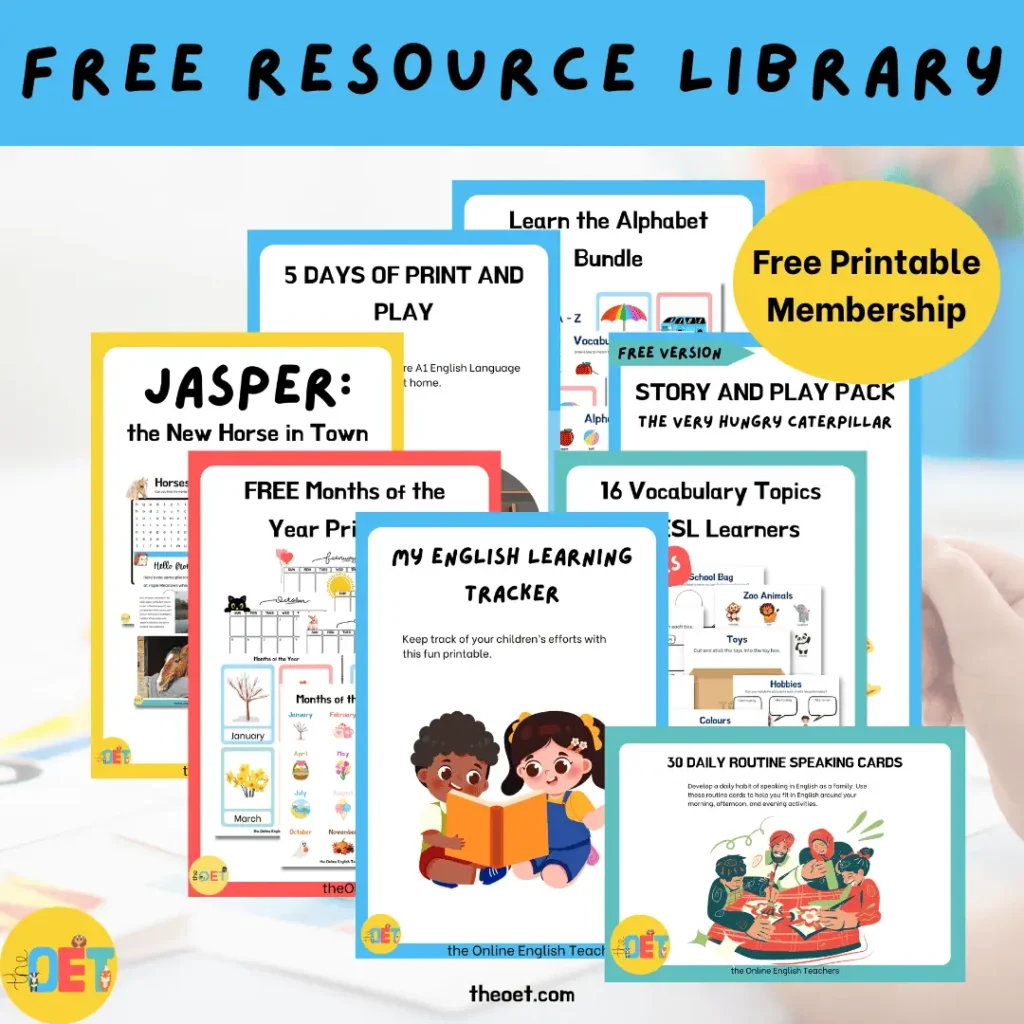
Join the FREE Resource Library
Looking for FREE quality printables, templates, and guides to help you teach your kids ESL at home?
Join theOET’s FREE Membership and gain access to 10s of resources designed by a qualified teacher to help your family learn English at home.
New resources are added every month. Save time, money, and stress with pre-made educational printables and guides.
The Power of Word Games in Language Learning
Word games offer a fantastic way to enhance your child’s English language skills. With word games, children can boost their vocabulary, spelling, grammar, and overall language proficiency.
Benefits of Word Games for Kids
Word games provide a stimulating environment for children to expand their language skills while having fun. By actively participating in games like Scrabble, charades, hangman, or crosswords, kids can improve their vocabulary retention and comprehension.
These games help enhance spelling accuracy as children learn to spell words correctly within the context of the game. This practical application of spelling rules can significantly benefit their overall literacy skills.
Grammar proficiency also sees improvements through word games as children are exposed to sentence structures, word order, and parts of speech in a practical and enjoyable manner. Engaging in activities like word association or word matching can help reinforce grammar concepts in a playful setting.
Overall, word games make language learning an interactive and engaging experience for kids. By incorporating games into their daily routine, children can develop a love for language learning while honing their English skills effortlessly.
20 Word Games for Families to Play Together
Engage your family in a world of fun and learning with these exciting word games that are not only entertaining but educational too. Playing word games together can foster better communication, boost vocabulary, and enhance language skills in an interactive and enjoyable way. Here are a variety of word games that families can enjoy together at home to enhance English language learning for children.
1. Charades
Charades is a fun and interactive game that not only sparks creativity but also enhances communication skills through the acting out of words and phrases. By engaging in charades, families can enjoy a fantastic opportunity to expand their vocabulary and linguistic expressions in a playful manner.
This game involves players taking turns to silently act out a word or phrase, while the other players guess what it is within a time limit. It encourages players to think on their feet, observe gestures and facial expressions, and communicate effectively without words.
Charades can be tailored to suit different age groups and language levels, making it an inclusive activity for the whole family to enjoy together.

2. Hangman
Enhance your child’s spelling and vocabulary skills with a fun and educational twist through the game of Hangman. This classic word-guessing game not only entertains but also encourages young learners to engage in critical thinking while immersing themselves in the world of language.
To play Hangman, one person thinks of a word and draws a blank line for each letter. The other players then guess one letter at a time, trying to uncover the mystery word. With each incorrect guess, a part of a stick figure is drawn, symbolising a piece of the gallows. The aim is for the guessing player to reveal the entire word before the stick figure is completed.
By incorporating Hangman into your child’s routine, you can provide them with an interactive way to boost their spelling accuracy and expand their vocabulary. This game offers a blend of entertainment and educational value, making learning an enjoyable experience for children as they master language skills organically.
3. Word Association
Word association games are a fantastic tool to foster creativity and enrich vocabulary. By linking words based on connections, these games not only stimulate the mind but also offer a playful way to discover new words.
Here’s how to play:
- Start Simple: Begin with a word, and then take turns with others saying related words. For example, if the starting word is “ocean,” responses could include “waves,” “beach,” or “seashells.”
- Themed Rounds: Try themed rounds where all responses must relate to a particular category. This adds an extra challenge and encourages deeper thinking.
- Time Limits: Introduce time limits for responses to keep the game fast-paced and exciting. This can also enhance quick thinking and word recall skills.
- Incorporate Learning: Use word association games as a tool to learn specific topics or subjects. For instance, associate words related to science, history, or literature.
4. Scrabble
Enhance your children’s word recognition, strategic thinking, and spelling skills with the timeless and engaging game of Scrabble.
Scrabble requires participants to score the most points by creating words on a game board using letter tiles. Each player draws seven letter tiles from a bag in the beginning. Players take turns forming words in a crossword fashion on the board, earning points based on the letters used and board spaces.
Challenge your family members in a friendly competition that promotes language development.

5. Categories
Improve word categorisation, quick thinking, and vocabulary expansion through the game of Categories. This game encourages players to think fast and enhance their language skills in a group setting.
To play Categories, start by gathering a group of players. One person selects a category, such as “colours,” and players take turns naming items within that category, like “blue,” “red,” or “green.”
By engaging in this fast-paced activity, players enhance word categorisation skills and expand their vocabulary in a fun and interactive way.
6. Word Bingo
Learn how to make learning words interactive and enjoyable with Word Bingo. This educational game combines the excitement of traditional bingo with vocabulary building and language skills practice. Word Bingo is a fantastic tool for reinforcing word recognition and enhancing language acquisition in a fun and engaging way.
To play Word Bingo:
- Create bingo cards with words instead of numbers. You can tailor the words to suit the skill level of the players.
- Call out definitions or synonyms of the words on the cards.
- Players mark the corresponding word on their bingo cards if they have it.
- The first player to complete a line, column, or full card shouts “Bingo!” to win.
By incorporating Word Bingo into your learning routine, you can transform language practice into an enjoyable activity that motivates and challenges learners of all ages.
7. Word Puzzles / Anagrams
Enhance your children’s spelling, problem-solving skills, and word recognition through engaging word puzzles such as crosswords or word searches. These interactive games not only provide entertainment but also offer significant benefits for language development. Word puzzles require players to think critically, expand their vocabulary, and sharpen their cognitive abilities. By deciphering clues and locating hidden words, children actively engage in a fun yet educational activity that stimulates their minds.
To play a crossword puzzle, your children need to read the clues carefully and fill in the corresponding boxes with the correct words. This process encourages them to think creatively, make connections between different words, and improve their understanding of various linguistic concepts. Word searches, on the other hand, involve finding specific words hidden within a grid of letters. This activity boosts visual processing skills and reinforces word recognition, helping children become more adept at identifying words in different contexts.
Introducing word puzzles into your children’s daily routine can diversify their learning experience and make language development an enjoyable journey. By incorporating word puzzles into your children’s playtime, you can nurture their intellectual growth while creating fun learning moments.
8. Pictionary
Boost your children’s visual communication skills, unleash creativity, and enhance vocabulary retention through the game of Pictionary. By combining the elements of drawing and word guessing, Pictionary offers a unique and stimulating way to develop language proficiency in a fun and interactive manner. Whether it’s sketching out clues or deciphering your opponents’ artistic creations, Pictionary provides an engaging platform for expanding language skills.

9. Memory Game
Enhance your children’s memory retention, boost concentration levels, and elevate vocabulary recall proficiency with educational Memory Games. By matching word pairs in this interactive activity, not only will your children refine their memory skills, but they will also enrich their language learning journey.
To play the Memory Game effectively, follow these instructions:
- Begin by laying out all cards facedown in a grid formation.
- Take turns flipping over two cards at a time to reveal the words beneath.
- If the words on the cards match, keep them and score a point.
- If the words do not match, turn them back over and try again.
- Continue playing until all pairs have been successfully matched.
Integrating the Memory Game into your routine not only provides mental stimulation but also offers a fun and practical way to enhance cognitive abilities.
Join the FREE Resource Library
Looking for FREE quality printables, templates, and guides to help you teach your kids ESL at home?
Join theOET’s FREE Membership and gain access to 10s of resources designed by a qualified teacher to help your family learn English at home.
New resources are added every month. Save time, money, and stress with pre-made educational printables and guides.
10. Tongue Twisters
Enhance your children’s pronunciation, enunciation, and verbal fluency through Tongue Twisters. These challenging yet entertaining word sequences provide a playful way to refine language skills and enhance speech clarity, making learning an enjoyable experience for your little ones.
To play Tongue Twisters, simply choose a phrase with repetitive or challenging sounds and encourage your children to repeat it as quickly and clearly as possible. This activity not only sharpens their articulation skills but also boosts their confidence in speaking effectively.
11. Rhyming Word Games
Rhyming word games are a fantastic way to boost phonemic awareness, spark creativity, and nurture language rhythm in an interactive and enjoyable manner. Here are some tips to get you started:
What Are Rhyming Words?
Rhyming words are words that have similar sounds at the end, creating a melodic pattern when spoken together. For example, “cat” and “hat” rhyme because they end with the same sound “-at.”
How to Play:
- Word Matching: Pick a word and challenge each other to find words that rhyme with it.
- Rhyme Stories: Take turns creating a story where each sentence ends with a rhyming word.
- Rhyme Race: Set a timer and see who can come up with the most rhyming words in a minute.
By incorporating these rhyming words games into your family time, you’ll not only have fun but also enhance your language skills together.
12. Spelling Bees
Spelling Bees are not just games; they are engaging activities that foster healthy competition, elevate spelling proficiency, and nurture self-assurance in children. By participating in a Spelling Bee, youngsters are challenged to decipher complex words.
To play a Spelling Bee, gather your family and friends for a friendly yet stimulating competition. Select a range of words that vary in difficulty to keep the game exciting and educational. Encourage each participant to spell out the words correctly, cheering them on as they demonstrate their spelling abilities.
This interactive and lively game is a fantastic way for children to enhance their spelling skills in a fun and supportive environment.
13. Story Cubes
Story Cubes are a fantastic way to boost storytelling skills and foster creativity within your family. Each cube features different images that act as prompts for creating unique and imaginative narratives. Here’s how you can get started:
- Gather the Family: Bring everyone together for a fun and engaging storytelling session.
- Roll the Cubes: Take turns rolling the Story Cubes to reveal the images on each face.
- Create a Story: Use the images on the cubes to weave a story together, incorporating all the elements that appear.
- Encourage Vocabulary Expansion: Prompt each family member to describe the images they see, helping to enhance their vocabulary.
- Explore the Power of Language: Discuss how choosing the right words can impact the story’s tone and message.

14. Word Jumbles
Word Jumbles are an engaging activity that challenges children to unravel scrambled letters, enhancing their problem-solving skills and reinforcing vocabulary.
To play, you can start by choosing a word jumble with varying difficulty levels, from easy to more complex challenges. Encourage your children to rearrange the letters to form meaningful words. You can even time how quickly they solve each jumble to add an element of excitement.
Incorporating Word Jumbles into your children’s routine can be a dynamic way to support their learning journey and foster a love for language exploration.
15. Taboo
Enhance your children’s vocabulary, comprehension of context, and descriptive language abilities by playing Taboo as a family. Taboo offers a stimulating challenge that requires participants to convey information with precision and creativity while refraining from using specific restricted terms. Players must employ alternative expressions and strategic communication to effectively convey their messages, fostering quick thinking and linguistic agility.
Taboo encourages players to think critically, adapt their verbal strategies, and enhance their communication skills through interactive gameplay. When playing Taboo, children can broaden their word choices and improve their articulation. Additionally, the competitive element of Taboo adds an exciting dimension to the learning process, making it a fun and engaging way to strengthen language proficiency.
To play Taboo, divide into teams and select a participant from each team to provide clues without using the forbidden words. Team members must guess the target word based on these clues within a specified time limit. This dynamic exchange of information promotes teamwork, quick thinking, and effective communication strategies.
16. Twenty Questions
Enhance your children’s critical thinking, questioning skills, and deductive reasoning with Twenty Questions. In this word-based game, players are prompted to ask yes-or-no questions to narrow down possible answers. This not only sharpens their strategic thinking but also broadens their vocabulary as they try to craft precise questions.
To start the game, one player thinks of an object, person, or place, whilst the others take turns asking up to twenty questions to guess the chosen item. The chosen player can only respond with “yes” or “no” until the guessing players either solve the mystery or run out of questions.
This fun and educational game encourages children to think on their feet, consider different angles, and refine their word choices to get closer to the answer.
17. Word Ladder
Word Ladder is a vocabulary game where players transform one word into another by changing one letter at a time. For example, to change “cat” to “dog,” you can switch the “c” to a “d” to make “dat,” then change the “t” to a “g” to get “dag,” and finally switch the “a” to an “o” to complete the transformation.
Players take turns to alter the word, ensuring each new word created is valid. This game is particularly beneficial for children learning English as a second language as it helps expand their vocabulary, improve spelling, and enhance their understanding of word relationships. By engaging in Word Ladder, children can develop language skills in a fun and interactive way, making the learning process more enjoyable and effective.
18. Mad Libs
Mad Libs is a fun and educational word game that sparks creativity and enhances language skills. The game involves players providing various types of words to fill in blank spaces in a story, resulting in hilarious and sometimes nonsensical combinations when read aloud.
To play, simply choose a Mad Libs story, ask players to suggest words without revealing the context, and then fill them in the corresponding blanks to create a unique and often hilarious narrative.
This process not only encourages vocabulary expansion but also reinforces grammar rules and sentence structure in a playful and engaging manner. By incorporating elements of storytelling and wordplay, Mad Libs make language learning enjoyable and effective for young learners, helping them grasp new vocabulary and sentence patterns.
19. What Am I?
Exploring the concept of ‘What am I’ helps children learning ESL understand different objects, animals, or professions through interactive guessing games.
Players provide clues for others to guess the answer, encouraging vocabulary expansion and critical thinking. This game fosters creativity and communication skills, making language learning enjoyable and engaging for young learners. It also promotes inclusivity and teamwork as children collaborate to solve each other’s riddles, creating a fun and dynamic learning environment.

20. Alphabet Game
The alphabet game is a fun and effective way for children learning English as a second language to enhance their vocabulary skills.
To play, participants must find a list of things that start with each letter of the alphabet, progressing from A to Z. This game not only helps children familiarise themselves with the English alphabet but also encourages them to think creatively and expand their vocabulary.
By associating words with real-life objects, children can better understand and remember the new vocabulary they learn.

Top Tips When Playing Word Games
In your journey to help your kids learn English, remember that the key is to make learning fun and engaging. By incorporating a variety of word games into your family time, you are not only providing educational value but also creating lasting memories with your children. Here are some top tips to help your children get the most out of these educational word games:
Keep the Momentum Going
As you explore different word games like charades, hangman, Scrabble, and more, keep the momentum going by introducing new games and challenges regularly. This will not only keep your kids excited about learning but also help them retain the language skills they have acquired.
Celebrate Progress and Effort
Don’t forget to celebrate the progress and effort your children put into learning English through these word games. Positive reinforcement and encouragement go a long way in boosting their confidence and motivation to continue improving their language skills.
Make Learning a Team Effort
Remember that learning English should be a team effort. Get the whole family involved in playing word games together. This not only creates a supportive learning environment but also strengthens family bonds through shared experiences.
Explore New Horizons
As you continue to explore word games for kids to learn English, don’t be afraid to step out of your comfort zone and try new games and challenges. Embracing variety and novelty in your learning approach can spark creativity and curiosity in your children’s language-learning journey.
Stay Consistent and Patient
Learning a new language takes time and patience. Be consistent in incorporating word games into your family routine and be patient with your children as they navigate the complexities of language learning. Remember, progress is gradual but consistent effort yields results.
Have Fun Along the Way
Above all, remember to have fun along the way. Learning English through word games should be an enjoyable experience for the whole family. Embrace laughter, creativity, and silliness as you dive into the world of language learning together. The joy of learning is just as important as the knowledge gained.
Keep Playing, Keep Learning
By exploring a variety of word games and making learning a fun and interactive experience, you are not only helping your children improve their English language skills but also fostering a love for learning. Keep playing, keep learning, and watch as your children’s language abilities grow with each game played.
Whether it’s a lazy Sunday afternoon or a lively family game night, these word games will not only entertain but also educate you, creating lasting memories and valuable language learning opportunities for your children.
Join the FREE Resource Library
Looking for FREE quality printables, templates, and guides to help you teach your kids ESL at home?
Join theOET’s FREE Membership and gain access to 10s of resources designed by a qualified teacher to help your family learn English at home.
New resources are added every month. Save time, money, and stress with pre-made educational printables and guides.
Related Posts
- 15 Interactive Storytelling Games for Children Learning the English Language
- Top Websites to Level Up Your Child’s English Vocabulary
- 11 Engaging Vocabulary Activities For Kids To Learn English
- How to Improve Your Children’s English Listening Skills
- Top Tips to Improve English Vocabulary For Your Kids

