
If you are looking to boost your kid’s English vocabulary, it’s important to offer a range of interesting, engaging, and hands-on activities for them to complete.
Teaching English vocabulary is crucial for a child’s language development, impacting everything from reading comprehension to overall communication skills. But how do you make learning fun and effective?
Children learn best when they are involved in active learning and enjoying themselves. When they have a positive experience, it helps motivate your kids and instil a love for learning from an early age.
From game-based activities and hands-on learning to outdoor adventures, there are numerous ways to engage children and make learning enjoyable. If you need support to create fun vocabulary activities for kids, then keep on reading. Here I share multiple activities and resources that are bound to improve your kid’s vocabulary skills.
Table of Contents
- The Benefits of Teaching Kids English Vocabulary
- 11 Engaging Vocabulary Activities for Kids
- Encouraging Continuous Learning and Practice
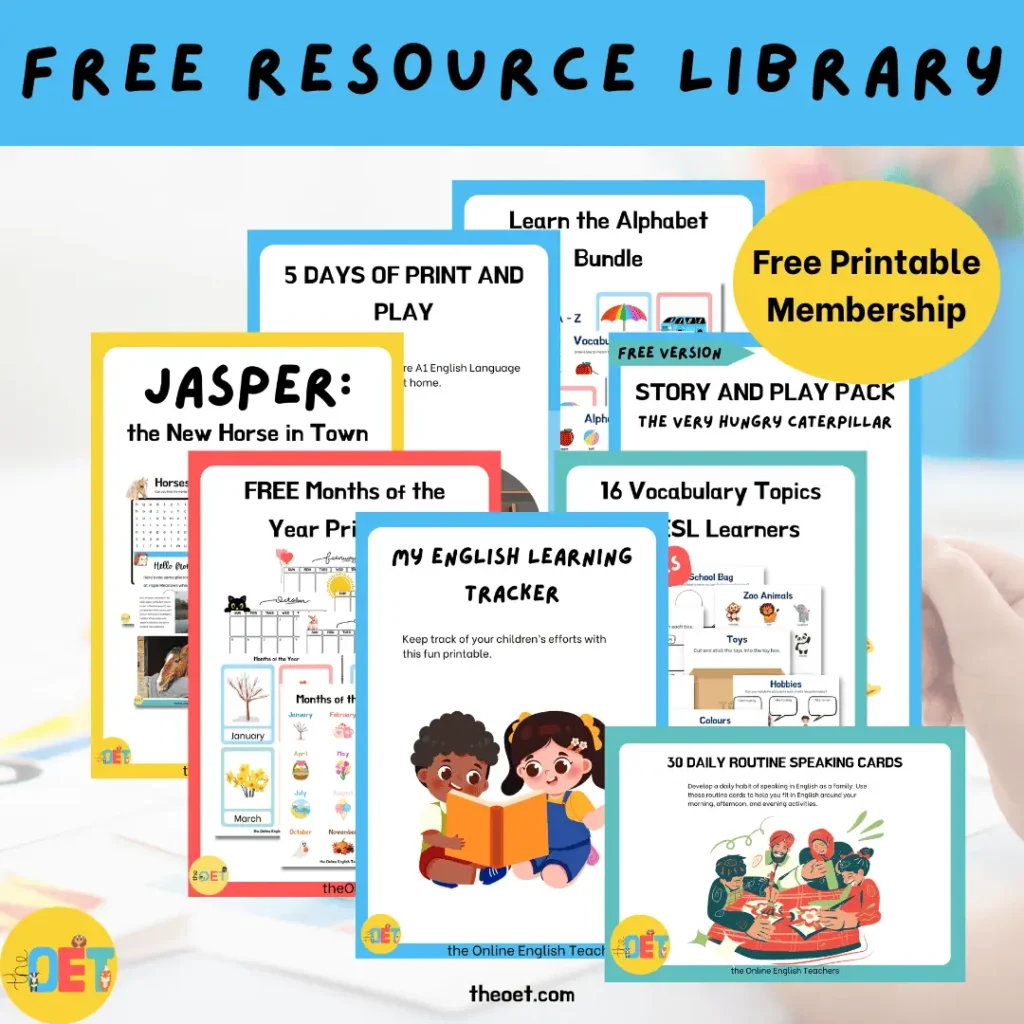
Join the FREE Resource Library
Looking for FREE quality printables, templates, and guides to help you teach your kids ESL at home?
Join theOET’s FREE Membership and gain access to 10s of resources designed by a qualified teacher to help your family learn English at home.
New resources are added every month. Save time, money, and stress with pre-made educational printables and guides.
The Benefits of Teaching Kids English Vocabulary
Teaching your children English vocabulary comes with a multitude of benefits that extend beyond just language acquisition. By introducing new words and expressions to your children in a fun and engaging way, you are setting them up for success in various aspects of their development. Here are some of the benefits your children will gain from expanding their English vocabulary:
Enhanced Communication Skills
Children can express themselves better, understand others more easily, and therefore communicate more naturally with an expanded vocabulary range. When they can do this, their confidence improves, and they will be more willing to communicate in English.
Improved Academic Performance
Learning new English words can significantly boost a child’s academic performance. A rich vocabulary enables them to comprehend texts better, write more fluently, and express their thoughts with precision. Children with a wider vocabulary range are better equipped to excel in reading comprehension, writing assignments, and overall academic achievement.
Cultural Understanding
Exploring English vocabulary exposes children to different cultures and perspectives. As they learn new words, children also learn about the world around them. Understanding diverse linguistic elements broadens their cultural appreciation and fosters empathy towards others. They can identify similarities and differences between people around the world, which helps develop inclusivity and understanding.

11 Engaging Vocabulary Activities For Kids
Diving into engaging vocabulary activities for kids can be both educational and entertaining. These activities are not only fun but also highly effective in helping children learn and retain new words.
For best results, try to incorporate a variety of these activities to help maintain your children’s interest and ensure their daily routine doesn’t become too repetitive. Utilise different resources available to you both online and offline to help balance screen time. Include multisensory activities to enable your children to connect and make sense of what they are learning.
Here are 10 varied and engaging vocabulary activities for kids that you can incorporate into your daily routine at home:
1. Interactive Storytelling Sessions
Storytelling sessions that help bring stories to life engage your children’s attention whilst exposing them to new vocabulary. An interactive storytelling session can involve reading a book together, creating your own stories, asking a range of questions and even acting out parts of a story using props, play dough story mats, or shadow puppets for example.
2. Word Games and Puzzles
Turn vocabulary learning into a game with word games and puzzles. Word search, crossword puzzles, and memory games are fantastic tools to make the learning process enjoyable.
Incorporating friendly competition or rewards can further motivate children to expand their vocabulary.
Related Post: Engaging Your Child’s Imagination: Story-Based English Learning Activities
3. Outdoor Vocabulary Scavenger Hunt
Incorporate nature-based learning with a vocabulary scavenger hunt. Encourage children to explore their surroundings, find objects, and identify them using newly acquired vocabulary.
This hands-on approach not only reinforces word meanings but also promotes physical activity and sensory learning.

4. Role-Playing with English Vocabulary
Engage children in role-playing scenarios where they can act out using new words they’ve learned. Encourage creativity and imagination by creating everyday situations or fun stories for them to enact. This interactive method helps children apply vocabulary in context, enhancing their language skills.
5. Online Learning Platforms
Make use of educational websites and apps that are specifically designed to enhance English vocabulary acquisition. Platforms like ABCmouse and Duolingo for Kids offer engaging games and activities that make learning vocabulary enjoyable.
Encouraging regular use of these online resources can supplement traditional learning methods and make vocabulary building more interactive for children.
Related Post: Interactive Learning on the Go: The Value of English Language Apps for Young Learners
6. Library Visits for Language Enrichment
Take a trip to your local library to immerse your children in a world of words. Libraries offer a wide range of English books suitable for children of all ages and abilities. From phonics to picture books, Bilingual stories to traditional fairy tales, your local library will likely offer books that interest your children and suit their reading level.
If you aren’t able to access a local library, or perhaps you don’t have a library near you, take a look at these online libraries instead:
- Open Library
- Oxford Owl Ebook Library
- Project Gutenberg
- Many Books
- International Children’s Digital Library
Encourage your children to explore different genres and subjects to discover new words and phrases. Reading together as a family can also foster a love for language and storytelling while expanding their vocabulary in a natural way.

7. DIY Vocabulary Flashcards
Create custom flashcards to reinforce vocabulary learning at home. Personalised flashcards with words and images that are meaningful to your children can make the learning process more engaging and memorable. Involve your children in creating flashcards with their own drawings, enabling them to practice handwriting and spelling.
Spend some time each day reviewing the flashcards with your children, using them in games and quizzes to help them retain the new words they have learned.
Join the FREE Resource Library
Looking for FREE quality printables, templates, and guides to help you teach your kids ESL at home?
Join theOET’s FREE Membership and gain access to 10s of resources designed by a qualified teacher to help your family learn English at home.
New resources are added every month. Save time, money, and stress with pre-made educational printables and guides.
8. Incorporating Music and Songs
Music is an excellent method of capturing children’s attention and enhancing their memory skills. English songs and rhymes can help your children memorise new words with catchy tunes, upbeat melodies, and easy-to-remember rhymes.
Classic songs and nursery rhymes such as 5 Little Ducks, 1, 2, Buckle My Shoe, and Twinkle Twinkle Little Star can be found on a variety of YouTube channels and podcasts for children.
9. Cooking Together to Learn English Terms
Involve your children in the kitchen to not only bond over cooking but also to learn food-related English terms. Encourage them to read recipes out loud, identify ingredients, and follow instructions in English. This hands-on approach not only expands their vocabulary but also teaches them practical skills in a fun and interactive way. Not to mention being immediately rewarded for their efforts by enjoying what they’ve cooked.
Start with simpler recipes such as making a fruit salad, boiling an egg, or making a sandwich. You could even incorporate stories and use cooking to help retain the vocabulary learnt e.g.
- The Little Red Hen: Bake bread and focus on using instructional verbs
- The Gingerbread Man: Make and decorate gingerbread men and sequence the story. You could also include quarter, half, three-quarters, and a whole whilst eating your gingerbread man pretending to be the fox.
- The Tiger Who Came To Tea: Create a tea party or afternoon tea and sequence what the tiger ate.
- Handa’s Surprise: Label and make a fruit salad.

10. Art and Craft Projects for Vocabulary Expansion
Enable your children’s creativity to flow with art and craft projects that stimulate vocabulary expansion. Engage them in activities like making a vocabulary scrapbook, where they can label objects, create flashcards, or draw pictures with English annotations.
Incorporate arts and crafts with storytelling sessions to practise vocabulary learnt. Create props such as finger puppets or even build a diorama/shoebox theatre with your children.
Through these projects, children can learn and retain new words while having fun expressing themselves artistically.
11. Family Language Games Night
Make learning English fun for the whole family by dedicating a weekly game night to English vocabulary games. Choose games that encourage vocabulary expansion, such as word association games, charades with English words, or even vocabulary bingo. This not only helps children learn new words but also fosters a love for learning through play.
Encouraging Continuous Learning and Practice
Consistency is important when it comes to teaching kids vocabulary. Daily exercises help reinforce what they have learned and strengthen their retention of new words. By incorporating short and engaging vocabulary activities into your child’s daily routine, you can create a lasting impact on their language development.
The key to success is to not go overboard with vocabulary drills, spelling tests, or written tasks. Many children become bored with these activities quickly and will resist learning English.
Keep activities varied, fun, and play-based whilst also ensuring that activities planned are short, yet regular. It is much better to study English for 10 minutes a day consistently than it is for 2 hours once a week.
Here are some tips to help your children enjoy participating in vocabulary activities:
Consistent Daily Vocabulary Exercises
Encourage your children to engage in simple vocabulary exercises every day. This can be as easy as incorporating new words into everyday conversations or playing quick word games. By making vocabulary practice a part of their daily routine, you lay a solid foundation for language learning. You could even create themed days from the vocabulary activities for kids listed above e.g.
- Monday: interactive storytelling
- Tuesday: arts and crafts to create puppets
- Wednesday: role-playing the story
- Thursday: make vocabulary flashcards
- Friday: Incorporate music and songs listening to Monday’s story as an audiobook or animated video
- Saturday: story-themed cooking session
- Sunday: visit the local library for next week’s book.
Involve The Whole Family
Include all members of the family in your children’s English language journey. From playing games to themed scavenger walks, cooking together and reading stories. There are many activities that families can do together and enjoy the learning process with one another.
Your children will be more encouraged and motivated to learn English if they have someone to study with but also a role model such as yourself to look up to.
From my own experience, my children have made a huge amount of progress in learning Chinese since I started to study it together with them. We watch YouTube videos together, listen to audio, write Chinese characters, and use simple vocabulary daily with one another. They see it as quality time with me whilst experiencing a new language. It makes it more enjoyable for them and also increases my awareness of what they need more support with.

Creating a Reward System
Motivate your children to improve their vocabulary by setting up a reward system. Offer small incentives or rewards for reaching vocabulary milestones or using new words in sentences correctly. This system not only incentivises learning but also makes the process enjoyable and engaging for children.
A reward system doesn’t have to be complex and can be adapted to suit your children’s interests, learning styles, or what motivates them. Here are some examples:
- Create a reward chart where your children can add a sticker of their choice to the chart for every 10 words they have learnt.
- For children who struggle to maintain their attention on one task, break up vocabulary learning into shorter sessions with a mini reward in the middle e.g. 5 minutes of vocabulary learning, 2 minute action song to encourage movement, and then another 5 minutes of vocabulary.
- Provide an incentive for the end of the week for your children to complete a vocabulary activity each day e.g. a trip to their favourite park, a family game night, or an activity of their choice.
Ideally, over time, your children will gain intrinsic motivation for learning English. This is where your children will want to study English themselves because they enjoy it and wish to improve vs. studying for an unrelated, external reward. However, realistically speaking, younger children will take time to develop their own internal motivation for doing something, so using external rewards can help positively encourage them.
If choosing to use a reward system, it is important that the reward focuses on the effort your children are making and not based solely on the outcome. Not all children will find learning a new language easy, and it can be quite challenging for them. It is important to focus on praising the fact that they continue to try rather than on how quickly they can learn English.
Likewise, try not to use a reward system against your children e.g. if you don’t study English today, you are not going to the park. Both of these methods will lead to negative outcomes where your children do not wish to study English, and the reward system discourages them.
Ensure to utilise a reward system in a positive and encouraging manner that excites your children and helps them to begin seeing the benefits of learning English and expanding their vocabulary from a young age.
Keep A Record
Make sure to keep a record of the vocabulary your children have learnt. This could be in the form of the vocabulary scrapbook mentioned above, or a language learning journal.
A record should include a list of vocabulary with definitions and examples of each word. This provides a record that your children can look back through and refer to but also provides them with a visual representation of their hard work and the progress they have made.
Teaching kids vocabulary can be both enjoyable and immensely rewarding. By engaging in a range of vocabulary activities for kids that make language learning interactive and fun, you create a positive and stimulating environment for your children.
Game-based activities, hands-on learning, and role-playing with toys offer dynamic ways to reinforce vocabulary. Utilising both online resources and offline experiences ensures a broad and rich exposure to English.
Encouraging outdoor play and incorporating educational games can significantly enhance your children’s vocabulary retention and improvement. By making language learning a delightful part of daily life, you set the stage for your children to not only learn but also love English.
Take the time to explore different resources and discover what works best for your family. Your consistent effort and encouragement will lead the way for your children’s success in mastering English.
Join the FREE Resource Library
Looking for FREE quality printables, templates, and guides to help you teach your kids ESL at home?
Join theOET’s FREE Membership and gain access to 10s of resources designed by a qualified teacher to help your family learn English at home.
New resources are added every month. Save time, money, and stress with pre-made educational printables and guides.
Related Posts
- Top Tips to Improve English Vocabulary For Your Kids
- How to Improve Your Children’s English Listening Skills
- 28 Of The Best English Apps For Children To Improve Their English Language Skills
- 15 Interactive Storytelling Games for Children Learning the English Language
- How To Use Fairy Tales To Teach Your Kids English

