

Getting started with teaching your children English at home feels like a big step, but you don’t need to do it alone.
Here at theOET, you’ll find guides, advice, and resources designed to make home-based English learning simple for every family.
If private lessons aren’t an option or you worry your own English isn’t perfect, you can still give your children the support they need. There are resources for every budget and skill level, so you can pick what suits your family best.
Remember why you began this journey: to help your kids learn English, to give them more choices in school and later on in life.
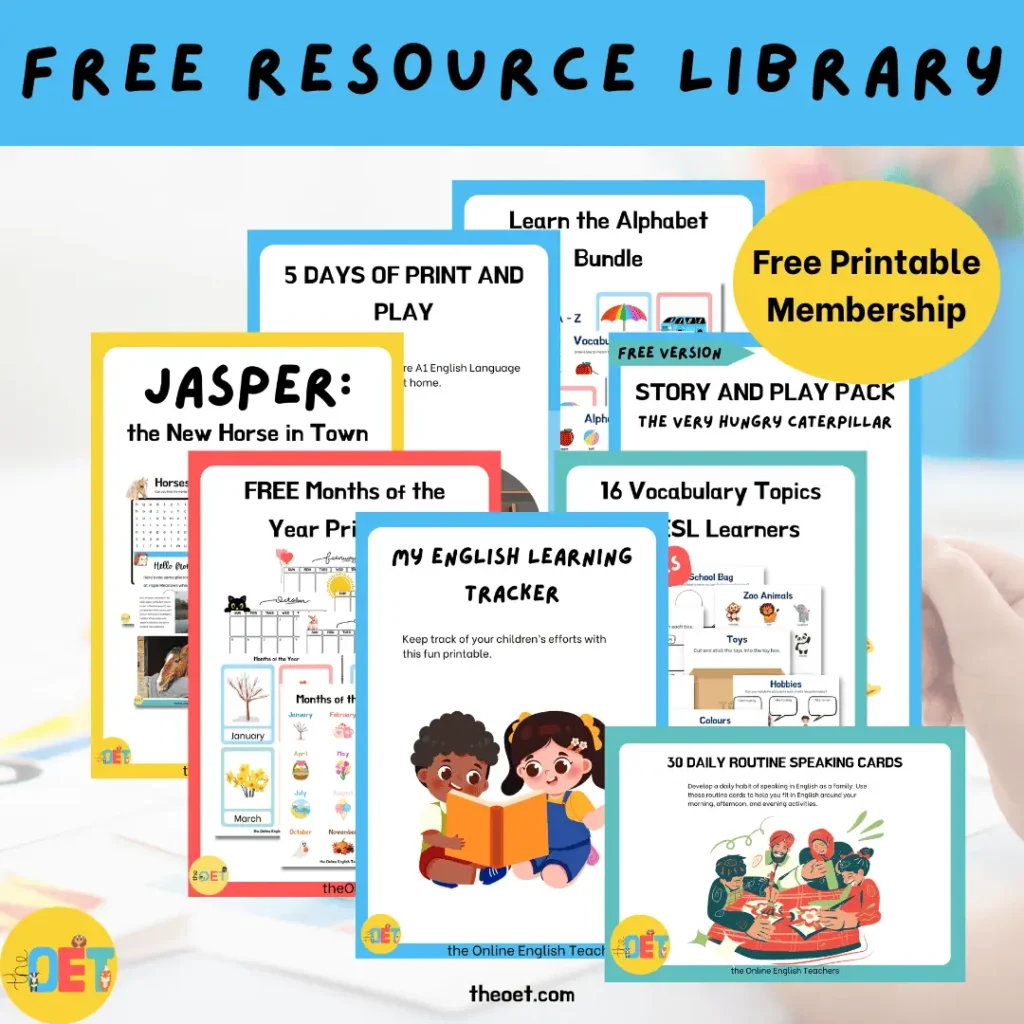
Join the FREE Resource Library
Looking for FREE quality printables, templates, and guides to help you teach your kids ESL at home?
Join theOET’s FREE Membership and gain access to 10s of resources designed by a qualified teacher to help your family learn English at home.
New resources are added every month. Save time, money, and stress with pre-made educational printables and guides.
Here are some top tips to help you get started:
- Begin by planning your time. Check your schedule and your children’s schedule. Map out your availability for when you will study English together with your children and/or when they will study independently.
- Consider assessing their current English level so you have a clear starting point. You can complete a free test here via the Cambridge English website to find out your children’s present ESL level.
- Once you know your available time and your children’s current level, complete theOET’s ESL study routine tool. It’s completely free and can give you an example activity schedule that is appropriate for your children’s availability, age, level, preferred method of learning, and considers the areas they need the most support.
- Try to fit in English wherever possible alongside your current schedule and usual family activities. Have an afternoon snack time? Great, use it as an opportunity to practice new vocabulary and speak in simple sentences e.g. “Yes, I would like a banana.” Do you read stories at bedtime? Incorporate bilingual stories, picture books, and move on towards chapter stories. You could take turns reading with your children, discussing the pictures, or pointing out new words. If you are looking for some story inspiration, these traditional folktales are some of our readers’ favourites.
- Relax and trust the process. Each child is different in how they learn best, what topics they find easier, and how quickly they improve. Try to focus on measuring the time and effort put in vs. the outcome. Remaining consistent is far more important and will lead to greater progress than intense study sessions, sporadic learning, or focusing solely on your children’s grades. Developing this outlook is also a more positive experience for your children, helping them to focus on their own learning path rather than stressing to achieve a specific grade in a given time frame.
Once you have an action plan in place, I highly recommend taking a look at some of my free resources and support:
On the Blog
- Engaging Your Child’s Imagination: Story-Based English Learning Activities
- This post helps introduce the concept of story-based learning for developing language skills. It also shares activities you can do to extend learning through stories, plus ways to access stories to read at home.
- 20 Fun and Educational Word Games for Kids Learning English
- Kids love playing, and what better way to learn English than through games? These word games are great for practising English vocabulary and can be enjoyed by the whole family.
- How to Teach English to Kids in a Fun Way
- If you’d like to learn more about children’s developmental stages and learning preferences, this is a great post. It will help you understand how your children learn and suggest activities to retain their interest.
- How to Use Flashcards for Families Learning ESL
- Flashcards are an excellent resource for children learning ESL, no matter their age or ability. They are so versatile and easy to adapt. Check out this post to find out more about how to use them.
- Top 11 Fable Stories for Kids to Build English Language Skills
- Stories are a great way to naturally immerse your children in language learning. Fables especially, are excellent for all age ranges and not only teach language skills, but also moral lessons and expose children to different cultures.
Youtube
Visit my Youtube channel, the Online English Teachers, for mini educational lessons. These lessons focus on:
- Core ESL skills e.g. vocabulary and phonics
- Story time with read-alouds and story-based activities
- Hands-on learning, such as drawing, crafts, and games.
These videos are free and short to retain children’s attention throughout. Watching these videos will help your children acquire foundational skills whilst you can finish off that cup of tea before it goes cold!
Community
Supporting your children’s education can feel daunting, especially when doing it solo. That’s why I launched a free community group hosted on Facebook to enable families to connect with one another and offer support.
This group provides top learning tips, activity ideas, resources, and answers to frequently asked questions, ensuring you don’t feel alone or overwhelmed while educating your kids.
Feel welcome to join my group and become a part of theOET community.

Join the FREE Community
Gain lots of activity ideas, book recommendations, freebies, and support to help you with everything you need for your children to succeed in their English language learning journey.
Free Resources
Every month, I create free educational resources to help families just like yours with teaching their kids English. From guides to vocabulary, storytelling tools to games, there is a growing library of free resources waiting to be used.
Join fellow ESL families in accessing all of these resources for free.
Join the FREE Resource Library
Looking for FREE quality printables, templates, and guides to help you teach your kids ESL at home?
Join theOET’s FREE Membership and gain access to 10s of resources designed by a qualified teacher to help your family learn English at home.
New resources are added every month. Save time, money, and stress with pre-made educational printables and guides.
No matter what stage your family is at in their English language learning journey, I hope you will join theOET’s growing community of like-minded families. Let me be your guide, take away the stress of planning and finding resources independently for your children, so that you can enjoy being present and learning alongside them.

