

If you’re looking for a story that builds English skills through kindness and courage, The Lion and the Mouse is a wonderful choice for your family. It’s simple enough for young learners to follow, yet rich in lessons about trust and friendship.
The story consists of a strong lion freeing a mouse. Later, the mouse returns the favour by freeing the lion from a trap. The moral is gentle and memorable: even the smallest of beings can help the biggest. That one idea gives you a lovely way of introducing the topics of respect and courage at home.
If your family is learning English, this fable offers short lines, everyday words, and repeatable phrases making it easy to read together. You can build vocabulary, practise simple sentences, and act it out to review the content covered.
In this post, you’ll find ready-to-use ideas you can try today, quick swaps for easier words, playful prompts, and mini activities that fit busy evenings. No extra books are needed, just a few minutes and your voices.By the end, you’ll have a friendly toolkit for reading, talking, and laughing together. This post will provide you with 10 The Lion and the Mouse Activities the whole family can enjoy together.
Join the FREE Resource Library
Looking for FREE quality printables, templates, and guides to help you teach your kids ESL at home?
Join theOET’s FREE Membership and gain access to 10s of resources designed by a qualified teacher to help your family learn English at home.
New resources are added every month. Save time, money, and stress with pre-made educational printables and guides.
Why The Lion and the Mouse Is Ideal for ESL and ELL Families
You want a story your children can understand, repeat, and enjoy. The Lion and the Mouse gives you all three. It’s short, friendly, and packed with useful language that you can return to again and again throughout the week.
The Lion and the Mouse is a clear, simple story
This fable follows a straightforward pattern: one kind act leads to another. Your children can follow the events easily, which means they can focus on English rather than plot twists.
- The structure follows a clean start–problem–solution arc, perfect for retelling.
- Only a few characters and keywords (lion, mouse, hunters, net) make it easy to track.
- Clear actions, e.g. sleep, catch, chew, free, are easy to mime and remember.
Opportunity to practice high-frequency vocabulary
Because the story uses everyday language, it gives children words they’ll come across in real life.
- Verbs: sleep, run, catch, roar, chew, help
- Nouns: lion, mouse, paw, rope, net, friend
- Feelings: kind, scared, brave, thankful
Use these in short patterns like “The lion is stuck.” “The mouse is quick.” “They are friends.” Repeating small, simple sentences gives rhythm and confidence.

Built-in repetition for fluency
The text’s rhythm makes it easy to echo. Try a short call-and-response after each line:
- You: “Who helps?” → Child: “The mouse helps.”
- You: “What breaks?” → Child: “The net breaks.”
This repetition improves listening and pronunciation without pressure.
Kindness builds social language
The moral (helping others) invites natural talk about good manners and empathy. Practise polite expressions from the story:
- “Please let me go.”
- “Thank you, good friend.”
- “I can help you one day.”
Action cues support beginners
Physical movement links words to meaning. Acting helps new vocabulary make sense: make a big paw, squeak like a mouse, pretend to chew ropes, or show stuck and free with your arms.

Adaptable for all ages and levels
You can simplify or extend the story depending on who’s listening:
- Younger learners enjoy short lines and animal sounds.
- Older learners can use why and because sentences.
- Advanced learners can discuss promises, trust, and friendship.
Bilingual connections lower stress
As The Lion and the Mouse exists in many languages, you can safely switch between English and your native language to support understanding. Compare short phrases like help you, help me, ” and ” help us.
Quick for busy homes
You can read the whole story in under five minutes. Small, regular moments count:
- Morning: two lines at breakfast.
- Car rides: echo key words like lion, mouse, net, free.
- Bedtime: one read, one short talk.

Easy to notice progress
You’ll hear improvement without the need for formal tests. Listen for clearer r and s sounds, smoother short sentences, and new English words being used in everyday play.
Confidence grows with courage
Seeing the tiny mouse help the mighty lion shows that small voices can make a difference. That message can help shy speakers feel brave enough to try, even with short phrases.
Use this story as your anchor text for the week. Keep lines short, tone warm, and practice daily. You’ll soon see steady growth in confidence and language.
10 The Lion and the Mouse Activities to Extend Learning
Reading the story is only the beginning. These hands-on activities help your children bring the Lion and the Mouse story to life through art, play, and imagination. Each one reinforces new words and values from the story.
Storytelling with Props
Turn your living room into a tiny stage and retell the story using everyday items. Children love matching words to objects, as it keeps them active and involved.
- Gather 5–7 props such as a towel for the net, a string for the ropes, a spoon for the paw, and a button for the mouse.
- Arrange them in story order and prompt with simple questions like “Who is stuck?” or “Who helps next?”
- Swap roles so children narrate while you move the props.
You could even turn this into a fun scavenger hunt. Offer your children clues for each item they need to find in your home.
Playdough Characters
Create a big lion and a small mouse from playdough to explore size and describing words. Talk as you work.
- “The lion is huge.” “The mouse is tiny.”
- Compare other pairs: big/small, long/short, heavy/light.
- Encourage two-sentence descriptions: “This lion is strong. This mouse is brave.”
Use these creations for other tasks such as describing the characters appearance, retelling the story, or making your own version of the story.
Nature Art Pictures
Take learning outdoors by collecting natural materials to recreate the story’s forest.
- Use twigs for the mane, leaves for the trees, and pebbles for the mouse.
- Label each part in English using sticky notes: forest, rope, net, friends.
- Say each word in a short sentence: “This is the net. The lion is in the net.”
Learning About Size Differences
Use the story to teach comparisons like big, bigger, biggest. Visuals help children grasp meaning quickly.
- Line up three pictures or toys and point as you speak: “Big… bigger… biggest.”
- Quiz with fun questions: “Which is bigger—the rope or the whisker?”
- Repeat with small/smaller/smallest or loud/louder/loudest.

Paper Plate Crafts
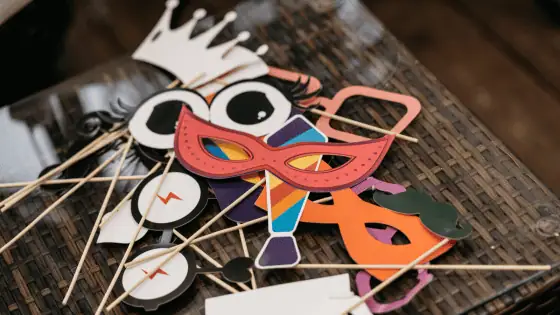
Masks are a fun way to act out dialogue and practise speaking lines with expression.
Cut eye holes in two paper plates and decorate one as a lion and the other as a mouse.
Try a short role play:
- Lion: “Who are you?”
- Mouse: “I am a mouse. Please let me go.”
- Lion: “I will help you.”
- Mouse: “Thank you. I will help you one day.”
Role-Playing the Story
Turn the fable into a simple three-scene play. Acting builds speaking confidence and memory.
Assign parts: lion, mouse, hunters, narrator.
- Scene 1 – “Stop!” “Please let me go.” “I will be kind.”
- Scene 2 – “Help! I am stuck.” “I am coming.”
- Scene 3 – “Chew, chew, chew.” “You are free.” “Thank you, friend.”
Add sound effects like roars and squeaks for fun. Take turns pretending to be each character and add your own dialogue to make it even more fun and creative.
Simple Drawing and Labelling
Drawing key moments helps children connect pictures to words.
- Choose three scenes, such as the meeting, the net, and the rescue.
- Add 1–3 word labels per picture (forest, paw, friends).
- Read each label aloud, then build a sentence: “The lion is in the forest.”
Moral Discussion Questions
Talk about kindness and friendship using easy, open-ended questions. This builds emotional vocabulary and empathy.
- “Why did the mouse help the lion?”
- “When can small friends help big friends?”
- “What kind words can we use at home?”
Connect their answers to daily life: “Today I can help by sharing my crayons.”
Animal Sound Games
Add some laughter to language practice with sound imitation games.
- Make an animal sound and let your children guess who it is.
- Combine actions: “Roar and run.” “Squeak and hide.”
- Build short sentences: “The lion is loud.” “The mouse is quiet.”
Finish with a fun game of Guess Who: “I am small and brave. Who am I?”
Create a Sequel Story
Extend imagination and vocabulary by inventing what happens next.
- Choose a new setting: river, cave, or village.
- Brainstorm words: bridge, storm, rope, safe, share, help, friends.
- Plan a short beginning, problem, and solution.
- End with a new moral such as “Friends help again and again.”

The Lion and the Mouse gives a warm, simple tale that teaches kindness and trust while building real English habits at home. Short lines, echo phrases, and clear actions help your children speak, listen, and read with confidence.
Pick from any of these 10 The Lion and the Mouse activities above to turn storytime into practice time. You’ll cover key skills from high-frequency words to polite requests without pressure. The moral keeps language useful and kind, and when children act, draw, and retell, they remember more and use new words sooner.
Ready to try one idea tonight? Pick a quick call-and-response or act out the net scene with props. Keep it playful, repeat key lines, and praise small wins; you’ll see steady progress in a week.
Share your wins in the comments: what made your children laugh, and which words did they pick up on?
Related Posts
- The Lion and the Mouse Story in English
- Top 11 Fable Stories for Kids to Build English Language Skills
- 12 Traditional Folktales from Around the World
- The Ant and the Grasshopper Story in English (Read-Aloud for ESL Families)
- How to Use Bedtime Stories to Teach English at Home
Hi, I’m Catherine
I help children learn English at home through stories and play with affordable and accessible resources. With over 10 years of experience educating children and over 5000 online ESL classes, I’ve learnt what methods work to keep children engaged and motivated to learn.
I look forward to helping your children develop their English skills!


