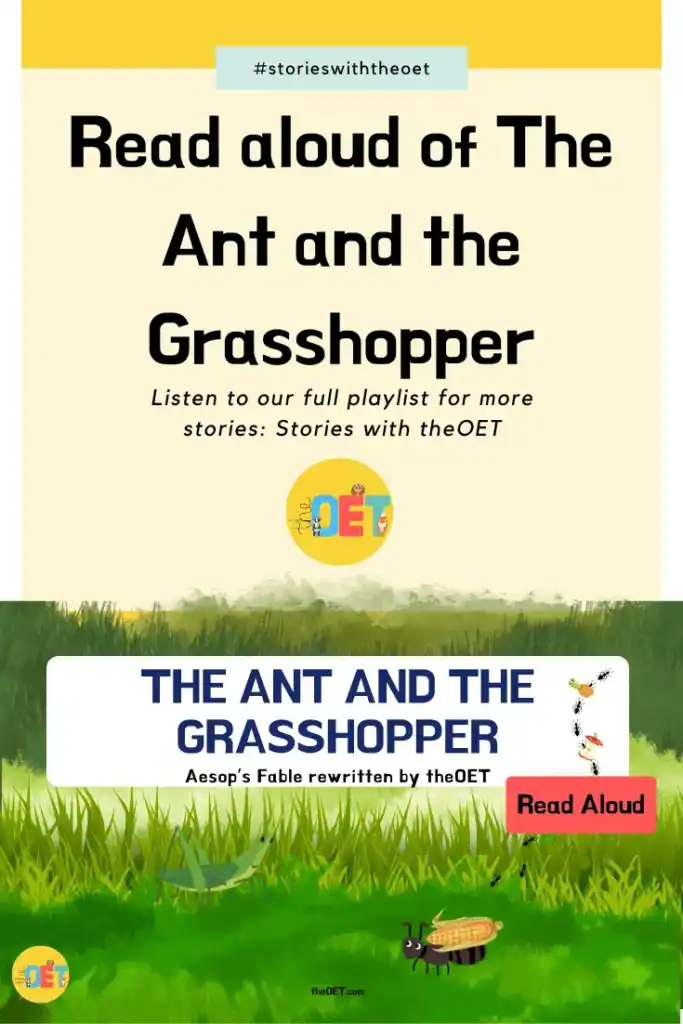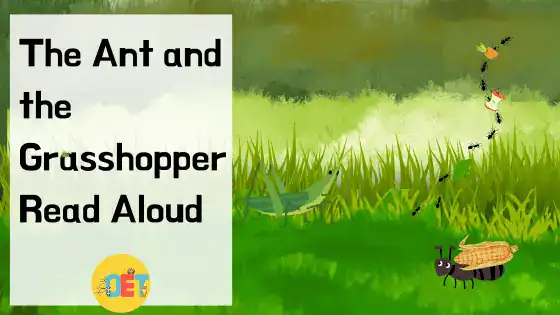
Looking for a simple story to share with your children that also builds early English skills? You will love this friendly retelling of the ant and the grasshopper story in English, adapted from Aesop’s Fables and rewritten by theOET for very young learners.
It uses clear language, short sentences, and a strong moral that children can understand. Not only that, but it introduces useful words about seasons, food, and daily habits.
What the Story Is About
You follow two characters who make very different choices. Ant works every day in summer, collecting seeds, leaves, and crumbs for winter. Grasshopper laughs, sings, and plays. The months pass and the weather changes. When winter comes, Ant is warm and fed, but Grasshopper is cold and hungry. Ant shows kindness, and Grasshopper learns a lesson about preparing for the future.
Why This Version Works for ESL Learners
This adaptation is made for early learners, especially pre-A1 to A1 levels. The language is simple, clear, and repeated in helpful ways. Your children can follow the story even if they have limited vocabulary.
Here are a few strengths you will notice:
- Short sentences with a clear subject and action.
- Repeated words like ant, grasshopper, food, winter, and play.
- Strong visual cues in the story sequence, from summer to winter.
- A kind moral that invites discussion without confusion.
Quick Summary of the Plot
Ant works hard in summer because winter will come. Grasshopper does not want to work, only to sing and play.
As time passes, the air grows cooler, leaves change colour, and food becomes hard to find.
Ant fills the nest and stays safe with friends. Grasshopper has no food and no home. He asks Ant for help. Ant forgives and shares food and shelter.
Grasshopper promises to prepare next summer.

Explore the FREE Resource Library
Fun, educational activities for children aged 3–8 completely free!
Discover a growing collection of printable games, vocabulary activities, crafts, and themed resources designed to help children build language and literacy skills through stories, play, and creativity.
Spend less time searching for activities and more time learning, playing, and creating together.
Main Characters and Their Choices
Understanding the characters helps your children reflect on their own habits and choices. It especially helps children understand that their actions can have different outcomes or consequences. Here is a gentle breakdown.
- Ant: Works daily, saves food, builds a safe home, and cares for friends. Ant also shows compassion when Grasshopper asks for help.
- Grasshopper: Chooses fun in the moment, ignores advice, and does not prepare. Later, he feels sorry and wishes he had listened.
You can ask, Who do you feel like today, Ant or Grasshopper? This playful question helps children connect behaviour with outcomes.
Key Vocabulary To Teach Before Reading
You can pre-teach a few words so your children feel more confident when they hear the story. Say them aloud and show a picture or action where possible.
- ant
- grasshopper
- food
- nest
- seeds
- leaves
- crumbs
- summer
- autumn
- winter
- cold
- snow
- warm
- home
- work
- play
- sing
A quick tip: keep the words visible while watching as a reference tool, perhaps on a small card or sticky note.
Seasons In the Story
The story moves through the seasons, which is helpful for early science and time words.
- Summer: hot days, plenty of food, Ant collects seeds and leaves.
- Autumn: cooler air, red and brown leaves, Ant continues to prepare.
- Winter: cold wind, white snow, food is hard to find, Ant stays warm in the nest.
You can point to a calendar and say, this is summer, this is autumn, this is winter. Children learn faster when you link words to real life as it offers context and meaning to those words.

A Simple Moral for Young Learners
The message is easy to grasp. Work a little now, enjoy safety later. Be kind to others, even when they make poor choices. Both ideas matter.
- Prepare for the future.
- Use time wisely.
- Help friends when they need you.
- Learn from mistakes.
You might ask, What could Grasshopper do next summer? Help your children suggest clear, simple steps.
Story Language Your Children Will Hear
Here are some short lines and phrases from the story that support early language skills. Use them to read to your children and encourage them to repeat after you:
- I must get ready now.
- Come and play with me.
- I cannot play. I must work.
- Winter will come quickly.
- I have plenty of time.
- It was hard to find food.
- I was foolish.
- I will help you.
- We have food to share.
Hearing these sentences helps your children build basic grammar. You can echo them during daily routines, for example, I must get ready now at bedtime.
Talking Points After Reading
A short chat after the story helps with comprehension and feelings. Try a few of these open-ended questions with your children:
- What did Ant do in the summer?
- What did Grasshopper do in the summer?
- What happens in winter?
- How did Ant treat Grasshopper at the end?
- What will Grasshopper do next summer?
If your children are very young, let them answer with one or two words. That is fine. The goal is to build up their self-confidence and encourage them to practice.
Simple Activities for Home Practice
Make the story part of your week. Small, fun tasks help encourage your children to participate, but also help them retain more:
- Act it out: One of you is Ant, the other is Grasshopper. Mime working, singing, jumping, and feeling cold or warm.
- Sort pictures: Cut out pictures of food, leaves, snow, and nests. Sort them into summer, autumn, and winter piles.
- Build a nest: Use a small box and line it with paper leaves. Add paper seeds or small beads as food. Talk about the words as you build.
- Word hunt: While watching, raise a hand when you hear ant or winter. Count how many times you hear each word.
- Draw and label: Draw Ant’s home and Grasshopper in the snow. Label food, nest, cold, warm.
Keep activities short, no more than ten minutes. Stop while interest is high.
Pronunciation Tips to Try Together
Help your children say key words slowly and clearly. Practice more than once to be able to hear any mistakes and add gentle corrections:
- ant: short a, like in cat.
- grasshopper: stress on grass, then hop, say per softly at the end.
- winter: win like victory, ter with a clear t.
- autumn: say aw-tum, with a soft n.
- crumbs: crum with b silent, then add s.
Say each word three times together. Change your voice e.g. silly or loud, soft, or whispering, to keep your kids engaged. Then use it in a short sentence, such as Ant carries crumbs.
Useful Phrases for Early Speaking Practice
Here are simple models your children can repeat after you. These sentences are particularly great for beginner, Pre A1-A1 language learners. They are simple, have a similar pattern, and use the vocabulary from the story:
- I am working.
- I am playing.
- It is summer.
- It is cold.
- I have food.
- I do not have food.
- I am sorry.
- I will help you.
Keep the tone light and praise every effort. Try not to put too much emphasis on corrections and perfection.
Mini Glossary
A small glossary helps you revisit terms later. Read the explanations aloud in easy language.
- Ant: A small insect that works in groups
- Grasshopper: A green insect that jumps and often makes music
- Nest: A small home for animals or insects
- Crumbs: Very small pieces of bread or cake
- Seeds: Small parts of a plant that grow into new plants
- Autumn: The season after summer, when leaves turn red/brown
- Winter: The cold season with snow in many places
- Prepare: Get ready before something happens
- Foolish: Not wise, making a poor choice
You can print this list or copy it onto a card. Keep it near your reading area so your children can refer back to it.

Reading Routine That Builds Confidence
A simple routine can make a big difference. You don’t need to spend hours each day studying to improve your children’s English skills. A simple 10-minute activity each day can help their language skills grow without stress or overwhelm. Repeat the story over a few days.
- Day 1: Watch and enjoy. Do not stop the video.
- Day 2: Watch again. Pause once per season to point to a picture or word.
- Day 3: Watch again. Echo short lines together, such as I must work.
- Day 4: Retell with pictures. Your children point and say one or two words.
- Day 5: Act out the story. Use props like paper leaves or a scarf for snow.
Consistency builds memory. Your children will start using the words in daily talk. I also like to encourage you to incorporate different activities throughout the week alongside reading/watching the story. For example, on Day 1, perhaps create a playdough version of the characters. On Day 2, you could play a simple flashcard game e.g. matching pairs with key words from the story. On Day 3, create a scavenger hunt game where your children have to find different items from the story and match them to their word list e.g. ant, grasshopper, seeds, fruit, etc.
Keep activities varied by incorporating not just storytelling, but also play and games. This is really effective in supporting your children’s language development, but also their enjoyment of learning English.
Kindness and Responsibility, Side by Side
This version offers something special. It praises hard work, and it praises kindness. Ant saves food, then Ant shares food. You can hold both ideas at once. Prepare for the future, and help friends who are learning.
You can say, we can be like Ant in two ways: we work and we share. Children understand this pair of ideas very well and can relate it to their own lives.
Extend Learning With Related Stories and Resources
If your children enjoyed this, you can keep building a gentle reading habit with similar texts.
- For simpler fables with clear morals, try the collection of fable stories for kids to build English language skills
- To explore traditional tales with beginner-friendly language, browse the set of traditional folktales from around the world
- For additional story read alouds, similar to this one, you can view our playlist on Youtube, English stories with theOET.
A small library of repeated, easy stories helps your children grow quickly. Familiar patterns, expanded vocabulary, and simple sentences can support their growth.
Quick Teaching Notes for Parents
Here are a few simple ways to make the most of this story at home.
- Set a calm mood: Read or watch at the same time each day, for routine and comfort.
- Use gestures: Point, mime, and smile. Your face and hands carry meaning.
- Repeat often: Children love hearing the same lines. Repetition builds memory.
- Praise effort: Say, good try, I heard winter, or I like your clear ant.
- Keep it short: Stop before your children are tired. Leave them wanting more.
You do not need to correct every mistake. Celebrate what goes well first.
Frequently Asked Questions
Here are a few quick answers you might find useful.
- What age is this story for?
- It suits young children and early readers, especially ESL learners at pre A1 to A1.
- How long should I spend on it?
- Ten to fifteen minutes is ideal for one sitting.
- Should I translate words?
- Use pictures and actions first. Translate only when needed.
- How many times should we repeat?
- Three to five times across a week works well.
Keep learning relaxed, as it helps your children feel safer and happier, leading to improved focus and enjoyment.
Stories can teach our children gently. They expose them to a new language in a natural way that they can relate to.
With the ant and the grasshopper story in English, you can guide your children to understand how small choices shape big outcomes. You can also show that kindness matters, even when someone made a mistake.
What story will you try next from theOET?
Explore the FREE Resource Library
Fun, educational activities for children aged 3–8 completely free!
Discover a growing collection of printable games, vocabulary activities, crafts, and themed resources designed to help children build language and literacy skills through stories, play, and creativity.
Spend less time searching for activities and more time learning, playing, and creating together.