

Grammar can feel overwhelming for children learning English as a second language, but a clear order can make the difference. Starting with simple concepts and gradually building upon each one ensures your children gain confidence and communicate effectively.
This guide will help you navigate the order to teach grammar, making lessons at home easier and simpler for your children to understand.

Table of Contents
- Why Order Matters When Teaching Grammar
- Start with the Basics: Nouns and Pronouns
- Move to Actions: Verbs
- Polishing Skills: Articles, Questions, and Negatives
- Develop Sentence Complexity: Adjectives and Adverbs
- Linking Ideas: Prepositions and Conjunctions
- Mastering Tenses: Past, Present, and Future
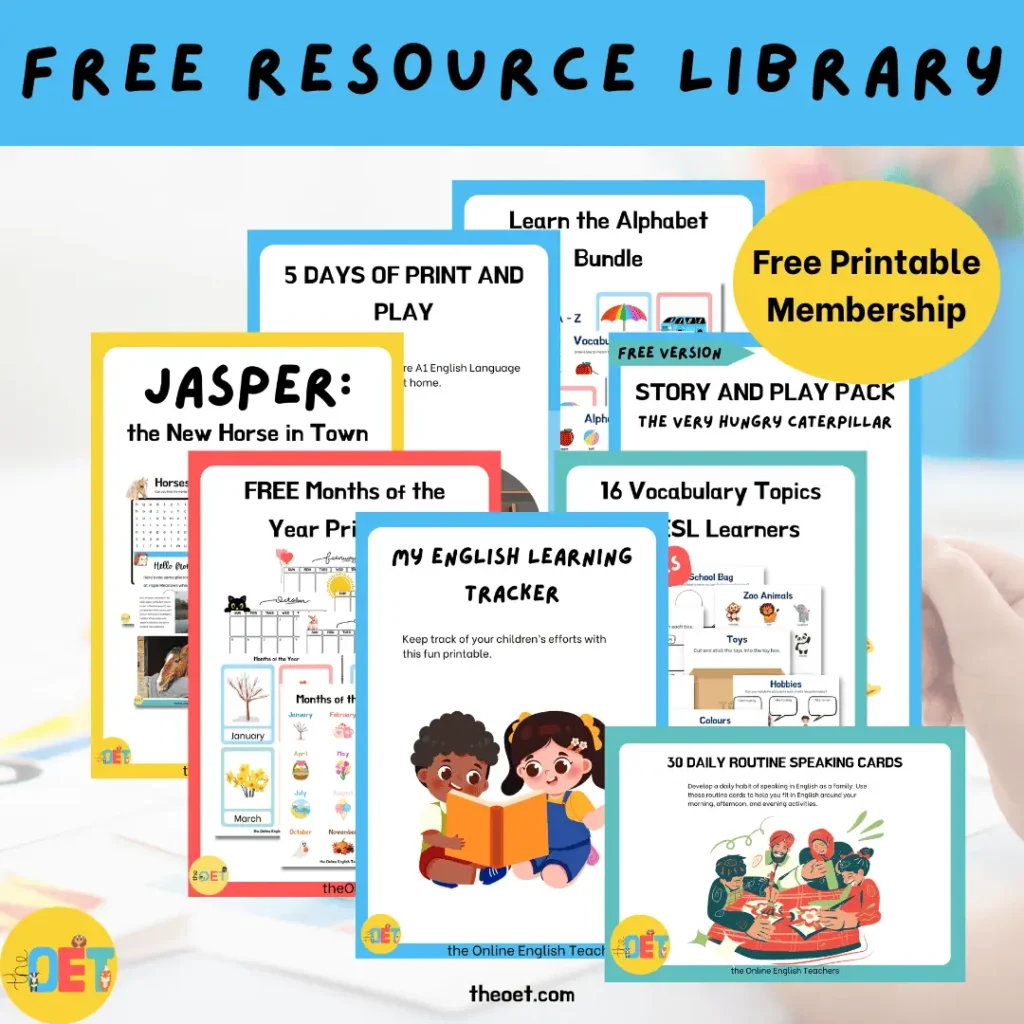
Join the FREE Resource Library
Looking for FREE quality printables, templates, and guides to help you teach your kids ESL at home?
Join theOET’s FREE Membership and gain access to 10s of resources designed by a qualified teacher to help your family learn English at home.
New resources are added every month. Save time, money, and stress with pre-made educational printables and guides.
Why Order Matters When Teaching Grammar
Teaching grammar in the right order isn’t just a teaching method; it’s about ensuring the process of building grammatical knowledge is smoother for you and your children. Providing them with a solid foundation will make it easier when adding additional steps.
When concepts are introduced step-by-step, each new rule supports what was previously learned, creating a sturdy structure. Jumping over foundational concepts leads to confusion and frustration, which can be tough for young learners. Here’s how offering an order to teach grammar will benefit your children:
Building Confidence through Simplicity
Starting with the basics allows your children to gain confidence early on. If you jump into complex grammar rules straight away, they may feel overwhelmed and struggle to keep up. However, teaching simpler concepts like nouns, verbs, and adjectives first sets a solid base.
For example:
- Teach a simple sentence like: “The dog runs.”
- Here, your children learn about nouns (dog) and verbs (runs) and how they can form a sentence together. Your children can then recreate this sentence structure using different nouns and verbs.
By grasping these fundamentals, they’ll feel more prepared to tackle harder concepts later. When your children feel successful, they’re more likely to enjoy the learning process and continue trying their best.
Avoiding Misunderstanding
Imagine teaching your children topics like punctuation and irregular verb forms early in the learning process. Without mastering foundational grammar, children will often mix up words, leading to mistakes that are tough to unlearn. Starting small and then layering more complex ideas ensures clarity.
For instance:
- Start with basic sentence structures like “She is happy. He is mad.”
- Then move to add more complexity like tense changes: “She was happy yesterday.”
Self-corrections are easier for children to spot when each grammar skill builds naturally on the last.

Strengthening Problem-Solving Skills
A structured order doesn’t just teach grammar, but it also helps your children learn how to approach problems logically. When you present grammar in a way that follows patterns, they’ll start spotting these patterns themselves. This makes it easier for them to tackle unfamiliar rules as they advance.
Making Grammar a Less Intimidating Subject
Approaching grammar step-by-step can transform it from an “intimidating subject” into something approachable and manageable. When children feel grammar “makes sense,” they’re less likely to view it as boring or hard.
A solid structure also gives you, as a parent, a clear roadmap to follow. This means less stress for you and more effective learning for them. An organised plan benefits your children’s progress and gives them skills they can build on.
Start with the Basics: Nouns and Pronouns
When teaching grammar, starting with the building blocks helps children develop a clear understanding of language structure. Nouns and pronouns form the foundation of most sentences. Introducing these concepts early will help your children build simple sentences quite quickly. Once they can do that, you can introduce additional concepts to extend their sentences and add more detail.
Teaching Nouns to Build Vocabulary
Nouns are the easiest entry point for children learning English grammar as they are often the first vocabulary words children are taught. They represent the people, places, and things your children interact with every day.
Here’s how you can teach your children nouns:
- Use Visual Aids: Show images of everyday items, or even better the physical item a word represents (e.g., ball, tree, cat) and name them. Pairing words with pictures helps children remember.
- Everyday Objects: Walk around your house and label objects with sticky notes. For example, label the “door,” “chair,” and “kitchen.”
- Sort Common vs. Proper Nouns: Create two piles of flashcards: one with names like “London” or “Sarah” (proper nouns) and another with general terms like “city” or “girl” (common nouns).
- Interactive Games: Play a scavenger hunt where your children find nouns in a room or on a walk outside.
Example sentences to practice with:
- Common noun: “She has a dog.”
- Proper noun: “Lucy lives in Paris.”
You could then write your children’s sentences or ask them to write and highlight in different colours to identify the differences between common and proper nouns. This activity will help review the concept of nouns before moving on.
Introducing Pronouns for Clarity
Once children are comfortable with nouns, pronouns are the natural next step. Poorly formed sentences often happen because learners stick to repeating nouns unnecessarily: “The cat is drinking milk. The cat likes milk. The cat sees a mouse. The cat chases the mouse.” Replacing repeated nouns with pronouns improves fluency and clarity.
To teach pronouns effectively, try these activities:
- Sentence Substitutions: Write a simple sentence with repeated nouns, such as: “Anna loves Anna’s toys.” Then, rewrite it with pronouns: “Anna loves her toys.” Have your children practise with more examples.
- Interactive Role Play: Assign roles with cards labelled “he,” “she,” “it,” “they,” etc. Read sentences aloud, and encourage your children to raise the correct pronoun card.
- Fill-in-the-blanks: Offer sentences with missing pronouns, such as “John is my brother. ___ is older than me.”
Make it fun by turning this into a quiz format where correct answers earn points.
Example sentences to guide practice:
- “Tom is at the park. He is playing on the swings.”
- “This is Sarah and Jack. They are my friends.”
By mastering pronouns, your children will communicate more clearly and develop the confidence to build more complex sentences.

Move to Actions: Verbs
Once your children understand nouns and pronouns, the next logical step in the order to teach grammar is action verbs. Verbs are an important element of sentences as they not only help build your children’s vocabulary but also help them share what is happening around them. Here’s how you can introduce this concept effectively.
Introducing Action Words
Action verbs can be fun for children to learn, especially if you use engaging and interactive methods. To make learning verbs an enjoyable experience, introduce them through games and storytelling. These approaches keep your children motivated while reinforcing the lessons.
Here are some ways to teach action verbs:
- Charades: Turn learning into a game by acting out verbs like “run,” “jump,” or “dance,” and ask your children to guess the word. Then reverse the roles to help reinforce understanding.
- Storytelling: Create a story together where your children select action words to complete sentences. For example “Once upon a time, a cat decided to ______ in the forest.” (run, climb, or explore)
- Verb Hunt: Read a short story or paragraph with your children and circle all the action words, such as “walks” or “talks.” This encourages them to spot verbs independently.
- Simon Says: Play word games such as Simon Says. Take turns with your children to give out commands and incorporate movement such as “Simon says Jump. Simon says Walk. Sit”.
Game-based learning not only makes study time enjoyable but also strengthens memory. Plus, when verbs are linked to actions they recognise, it becomes easier for them to retain the vocabulary.

Basic Sentence Formation
After your children are comfortable identifying action verbs, it’s time to work them into sentences. Teaching the subject-verb-object sentence structure is a great place to start. This allows children to grasp how nouns, pronouns, and verbs interact to form meaningful sentences.
Here’s how to introduce sentence formation:
- Start Simple: Use sentences like: “The dog barks.” or “She runs fast.”
- Combine Concepts: Mix the nouns and pronouns you’ve already taught with the new action verbs. For example “Tom eats an apple.” or “They play football.”
- Guided Practice: Create fill-in-the-blank exercises such as “The bird ______ in the sky.” (flies, sings) or “He ______ his homework every evening.” (does, finishes)
- Visual Aids: Use pictures to inspire sentence creation. Show a photo of someone jumping or swimming and ask your children to describe the action in a sentence.
By following these methods, your children will begin forming clear and grammatically correct sentences. This step is crucial in order to teach grammar, as it builds your children’s ability to communicate effectively.
Once they’ve mastered sentence construction, you’ll be ready to tackle more advanced topics like tenses and modifiers. But with verbs, you’re already empowering them to express ideas with clarity and confidence.
Join the FREE Resource Library
Looking for FREE quality printables, templates, and guides to help you teach your kids ESL at home?
Join theOET’s FREE Membership and gain access to 10s of resources designed by a qualified teacher to help your family learn English at home.
New resources are added every month. Save time, money, and stress with pre-made educational printables and guides.
Polishing Skills: Articles, Questions, and Negatives
Mastering articles, forming questions, and creating negatives are essential grammar steps for any ESL learner. These skills help your children build confidence in sentence structure and communication, plus aid in comprehension and writing skills. Here’s how you can teach these topics effectively.
Using Articles Correctly
Articles like ‘a,’ ‘an,’ and ‘the’ might seem minor, but they play a major role in sentence clarity. Teaching your children how to use them in context helps avoid confusion.
- ‘A’ vs. ‘An’: Teach your children that ‘a’ precedes words starting with consonant sounds (e.g., “a cat”), and ‘an’ is for vowel sounds (e.g., “an apple”).
- Using ‘The’: Explain that ‘the’ points to something specific or previously mentioned, like “The dog is barking.”
- Practice with Examples: Create sentences together:
- “I see a tree.”
- “She saw an eagle in the sky.”
- “The book on the table is mine.”
Interactive games, like asking your children to sort objects into “a” and “an” categories, can be both fun and educational.
Building Question Structures
Learning to form questions is a crucial part of English communication. Start with simple structures and gradually add complexity.
Steps to Practice:
- Yes/No Questions with Auxiliary Verbs:
- Use ‘do’ or ‘does’ for present tense.
- “Do you like apples?”
- “Does she go to school?”
- For ability, ‘can’ works well:
- “Can you swim?”
- Use ‘do’ or ‘does’ for present tense.
- Forming Wh- Questions: Introduce words like ‘what,’ ‘where,’ or ‘why.’
- “What is your name?”
- “Where do you live?”
- Role-Playing Practice: Take turns asking questions using various prompts. For example:
- “What do you want to eat?”
- “Can I help you?”
These small practices help your children get comfortable with building question structures naturally.

Making Negative Sentences
Using negatives allows your children to express what didn’t happen or what isn’t true. By understanding how to work with ‘not’ and auxiliary verbs, they can share ideas more accurately.
Start with the Basics:
- Present Simple Negatives:
- “I do not like carrots.”
- “He does not watch TV.”
- Using ‘Can’t’ for Ability:
- “I can’t ride a bike.”
- Introduce Contractions Gradually: Explain that “does not” becomes “doesn’t,” “cannot” becomes “can’t,” and so on.
- “We don’t have a cat.”
- “She wasn’t at the park.”
Include fill-the-blank exercises to reinforce lessons:
- Example: “I ____ not like bananas.” (do)
These step-by-step approaches to articles, question structures, and negatives simplify grammar learning for your children. Keep lessons interactive and engaging to ensure progress and confidence. If you need more strategies, check out How to Help Your Child with English Grammar.
Develop Sentence Complexity: Adjectives and Adverbs
Introducing adjectives and adverbs is key to helping your children create more detailed and engaging sentences. These components bring colour and depth to language, making it more expressive and versatile. Here are some practical ways to teach these concepts.
Teaching Adjectives with Visual Cues
Adjectives describe nouns by adding details about size, colour, shape, and more. Using visual cues can make this idea more concrete for children, particularly those learning English as a second language.
How can you use visual aids to teach adjectives? Here are a few strategies:
- Use Picture Cards: Show your children an image of, for example, a “red ball” or a “big house,” and ask them to describe what they see. Then guide them to use those adjectives to form a simple sentence e.g. “The ball is red” or “The house is big”.
- Everyday Objects: Pick items around your home, like a “round clock” or a “soft cushion.” Ask your children to describe these objects, focusing on adjectives.
- Sorting Games: Create a sorting game by categorising adjectives (e.g., size: big, small, tiny; colour: blue, green, yellow).
Once your children are comfortable identifying adjectives, encourage them to add their own descriptive words to sentences. This step reinforces their ability to recognise and use adjectives naturally in speech and writing.

Adding Depth with Adverbs
Adverbs provide extra information about verbs, adjectives, or other adverbs. They explain how, when, where, or to what extent something happens. Incorporating adverbs into sentences helps children express themselves more fully.
Here are a few practical ways to teach adverbs:
- Start with Actions: Pick a verb, like “run.” Then ask, “How do they run?” Possible answers might include “slowly,” “quickly,” or “silently.” This introduces adverbs in a way children understand.
- Provide examples first to help demonstrate what it is your children should be doing. Show how adverbs modify verbs in action e.g. “She speaks softly.” or “He runs quickly.”
- Matching Words Game: Create a word-matching exercise where students pair verbs with adverbs, like “jump high” or “write neatly.”
- Expand with Adjectives: Explain that adverbs can also give more detail to adjectives. For example “The cake is very sweet.” and “She is extremely tall.”
Encourage your children to experiment by adding adverbs to simple sentences. For instance:
“The boy walked.” can become, “The boy walked slowly.”
These small additions show your children how to add depth and complexity to their sentences. Teaching adverbs alongside adjectives allows them to expand upon simple sentences, adding additional details and interest.
Linking Ideas: Prepositions and Conjunctions
When your children begin forming basic sentences, understanding how to link ideas helps improve sentence flow and structure. Prepositions and conjunctions are essential tools for this. They serve as the glue connecting words, phrases, or clauses, creating more meaningful and fluid communication.
Introducing Prepositions for Sentence Flow
Prepositions show relationships between nouns or pronouns and other parts of a sentence. These relationships typically indicate time, place, or direction, which helps children understand how elements in a sentence connect.
Here are three common types of prepositions and how they’re used:
- Time: Words like before, after, during.
- Example: “We’ll eat lunch after the meeting.”
- Place: Examples include at, on, under.
- Example: “She’s sitting under the tree.”
- Direction: Use words such as towards, into, over.
- Example: “He ran towards the door.”
To teach prepositions effectively:
- Use Visuals: Work with objects around the house. For instance, place a book “on” the table, then “under” it. This lets kids physically see and interact with prepositions.
- Practice with Pictures: Show illustrations and ask your children to describe the relationships. For example, ask: “Where is the cat?” Your children might say, “The cat is on the mat.”
- Interactive Games: Play games like “Simon Says” using prepositions: “Put your hand over your head.”
Prepositions may be short words, but they play a powerful role in constructing a precise message. Make lessons practical and visual, as prepositions are easier to grasp when connected to real-world examples.

Building Bridges with Conjunctions
Conjunctions link words, phrases, or sentences, and they are key to fluency. They help children move from simple sentences to more complex ideas. Without them, sentences would feel choppy or disconnected.
The three main types of conjunctions include:
- Coordinating Conjunctions: These are your everyday words like and, but, or. Example: “Tom likes apples and bananas.”
- Subordinating Conjunctions: These include because, although, while, and show cause-effect or time relationships. Example: “She stayed home because it was raining.”
- Correlative Conjunctions: Pairs like not only…but also, either…or. Example: “Not only is she singing, but she’s also dancing.”
Here’s how you can teach conjunctions effectively:
- Combine Simple Sentences: Start with two separate ideas: “I am tired. I will take a nap.” Then demonstrate how to join them with a conjunction: “I am tired, so I will take a nap.”
- Sort Conjunction Types: Create flashcards for different conjunctions and group them by type. This can help children learn where specific conjunctions fit.
- Sentence Race: Write sentence fragments on cards and ask your children to choose the correct conjunction to connect them.
By understanding conjunctions, your children can express more nuanced relationships between ideas, making their speech and writing far more engaging. This skill significantly enhances their ability to communicate both casually and academically.
Mastering Tenses: Past, Present, and Future
Teaching tenses is a vital step in grammar learning. It equips your children with the ability to express not only current actions but also events from the past and plans for the future.
Tenses act like time markers, describing when something happens, and mastering them opens the door to more meaningful communication. Take a look at some effective strategies for introducing and practising tenses with your children.
Focusing on Present Tense for Immediate Use
The present tense is the backbone of everyday conversations, making it the most practical starting point. Since children often discuss what’s happening around them, the present simple tense feels immediately relevant and usable. By focusing on this tense first, you provide your children with tools to describe their world confidently.
Here’s how to make learning the present simple tense easy:
- Use Visuals: Show pictures or objects and ask what they are doing. For example, “The boy runs” or “The dog sleeps.”
- Routine Activities: Tie lessons to daily activities. Discuss simple sentences like, “I eat breakfast” or “We walk to school.”
- Positive, Negative, and Questions: Teach all forms of the tense:
- Affirmative: “She plays football.”
- Negative: “She does not play football.”
- Question: “Does she play football?”
- Practice with Repetition: Turn sentences into a game. For example, say a verb like “eat” and ask your children to use it in a sentence: “I eat apples every day.”
The present tense helps your children describe their immediate experiences. Once they feel confident, they can easily build on this foundation as you introduce other tenses.

Gradually Introducing Past and Future Tenses
Once your children feel comfortable with the present tense, it’s time to introduce the past and future, one step at a time. These tenses allow children to expand their stories, share memories, and explain plans, which are exciting skills to develop.
For the Past Tense:
- Start with Regular Verbs: Begin with simple verbs that follow a pattern, like walked, played, or cooked. Give examples like “Yesterday, I walked to the park.”
- Introduce Irregular Verbs Slowly: Move on to irregular verbs like went or ate. Use practical examples such as “Last week, we went to the zoo.”
- Storytelling Activity: Using flashcards with images (e.g., a boy flying a kite), ask your children to create a sentence in the past tense: “He flew a kite last Sunday.”
For the Future Tense:
- Start with ‘Will’: Use simple future constructions like “I will go to school tomorrow.”
- Timeline Exercises: Draw a line with “yesterday,” “today,” and “tomorrow” labelled. Place events on the timeline and describe them using past, present, or future. For example:
- “We ate dinner yesterday.”
- “We are eating dinner now.”
- “We will eat dinner tomorrow.”
- Incorporate Fun Predictions: Ask your children, “What will you do at the weekend?” Encourage answers using “will”.
Linking tenses to your children’s daily life helps them see their value. From a practical standpoint, storytelling and timelines make grammar learning hands-on and engaging. Once they’ve mastered these skills, your children will feel more prepared to communicate in various situations.

Teaching grammar in the right order builds confidence and clear communication. Begin with nouns and pronouns to establish a strong foundation. Progress to verbs, adjectives, and adverbs to enhance sentence formation and detail. Add prepositions and conjunctions to help connect ideas smoothly, and finish with tenses for expressing time.
This clear sequence ensures your children avoid confusion and build skills step by step. Follow these strategies to make grammar learning engaging and effective.
Join the FREE Resource Library
Looking for FREE quality printables, templates, and guides to help you teach your kids ESL at home?
Join theOET’s FREE Membership and gain access to 10s of resources designed by a qualified teacher to help your family learn English at home.
New resources are added every month. Save time, money, and stress with pre-made educational printables and guides.

