

Learning how to teach English writing to beginners is just one piece of the puzzle of learning English. Strong writing skills are an important part of learning English as a second language. Being able to write, can help your children formulate better sentences, use and review vocabulary, understand grammar and punctuation, and improve their overall English ability.
Teaching your children writing skills alongside introducing new vocabulary will help to consolidate what they are learning and strengthening their knowledge along the way.
But how do you teach English writing to beginner language learners? It’s important not to make it too complex in the beginning. With simple vocabulary words, learning how to form English letters, and gradually building sentences. This gentle introduction will help minimise over-challenging your children and encourage them to practise their writing skills over time.
Keep reading this post to find out what English writing skills to teach, activity ideas, and some of the common challenges learners might face to help you teach English writing to your beginner language learners effectively.
Key takeaway: English writing skills aren’t just about practising letters and words; it’s about helping to consolidate prior learning and gaining more experience as an English language learner. Teaching your children writing skills does not have to be challenging, the process can be fun and enjoyable. With patience and consistency, you can guide your beginner learners to become confident writers.
Table of Contents
- Understanding the Basics of English Writing
- Strategies for Teaching Writing to Beginners
- Common Challenges in Learning to Write
- Engaging Writing Activities for Beginners
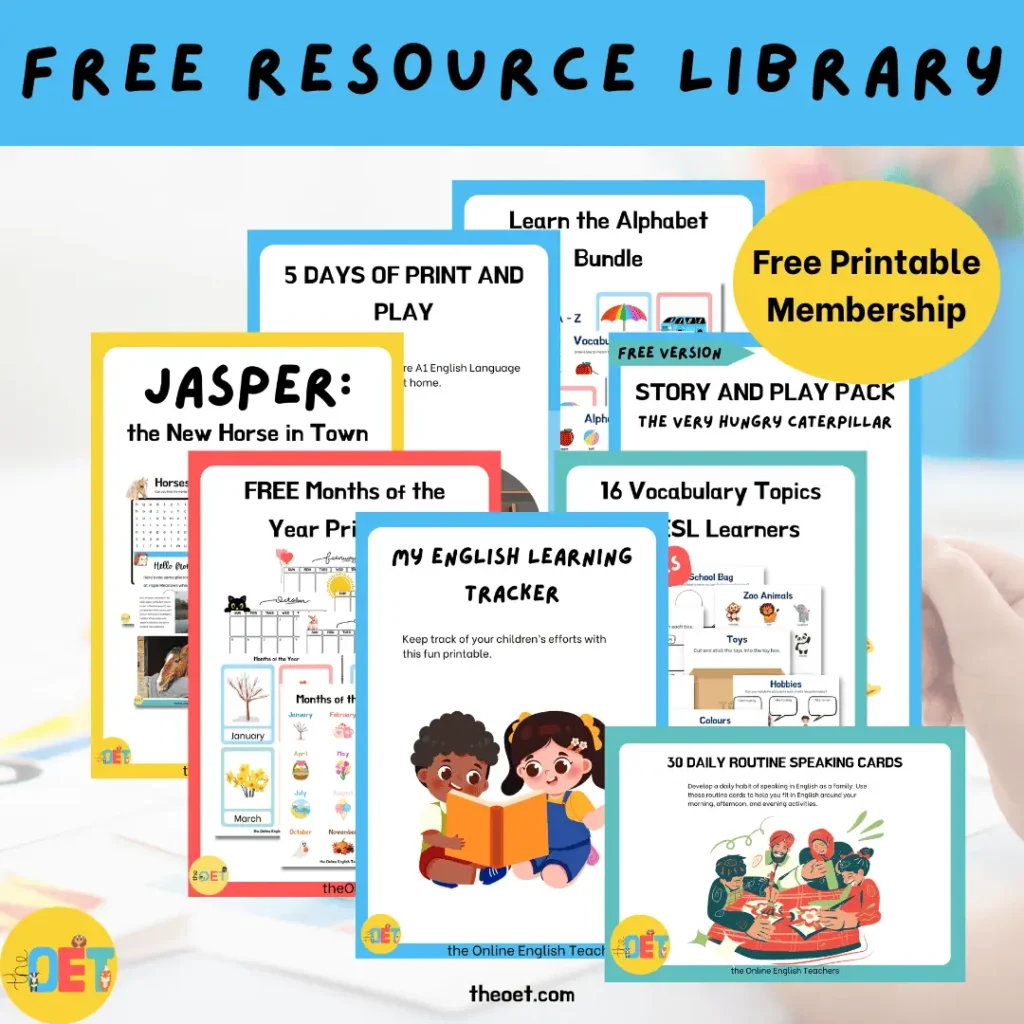
Join the FREE Resource Library
Looking for FREE quality printables, templates, and guides to help you teach your kids ESL at home?
Join theOET’s FREE Membership and gain access to 10s of resources designed by a qualified teacher to help your family learn English at home.
New resources are added every month. Save time, money, and stress with pre-made educational printables and guides.
Understanding the Basics of English Writing
For families with children learning English as a second language, mastering the basics is a key stepping stone on the journey to clear and effective writing. So how do you ensure your child’s writing journey starts on the right foot?
Alphabet and Phonics
Think of the English alphabet as the building blocks of the language. Not simply recognising each letter, but also learning the sounds they make, is crucial for writing skills e.g. spelling. Phonics is the format taught to children in English schools, helping them learn how to read and write from an early age. Just like native English speakers, ESL learners will benefit substantially by incorporating phonics early on.
Here’s why learning the alphabet and phonics matters:
- Foundation for reading and writing: knowing the letter sounds and the additional sounds letters can make when joined together e.g. digraphs (she, ch, re) and trigraphs (ear, igh, air) will assist your children to read and write.
- Improves spelling: being aware of the sounds of the letters helps in spelling out words correctly, as they are able to decode words into smaller segments e.g. chair can be split into “ch” and “air”.
- Pronunciation skills: Good phonics awareness aids in pronunciation, crucial for clear communication.
- Handwriting: understanding and practising how to write the letters of the English alphabet will aid in improved handwriting, leading to increased readability.
Sentence Structure
As with most languages, there is a formula to our sentences. With each element taught, your children’s ability to create more complex and interesting sentences increases.
When teaching beginner writers, it’s important not to get ahead of yourself. Start with the basics and build upon this slowly and steadily to allow children time to practise and consolidate prior knowledge.
A good starting point is to introduce:
- 1. Subject: Who or what the sentence is about?
- 2. Verb: What the subject is doing.
- 3. Object: Who or what is affected by the action?
A simple sentence like “The cat (subject) chases (verb) the mouse (object)” demonstrates these components simply yet effectively.
By focusing on these three elements, your child will be able to form clear and correct sentences early on, which is a vital skill for expressing their thoughts and ideas.
Related Post: The Best Order to Teach Grammar to ESL Learners
Punctuation
Punctuation is also an integral part of teaching English writing to beginners. It helps add pace and expression to sentences, along with structuring sentences properly to convey the correct meaning.
Here are some examples of how punctuation is an important element of learning to write:
- Clarifies meaning: Commas, full stops, and question marks help the reader understand the rhythm and intent of your writing.
- Signals sentence starts and proper nouns: Capitalisation highlights important elements like the start of a sentence or names of people and places.
- Adds emphasis: Exclamation marks can turn a simple statement into an exciting announcement.
Adding accurate punctuation can make a huge difference to how readers will interpret your children’s writing. For example, “let’s eat Grandma” has a completely different meaning to “let’s eat, Grandma.”
Teaching these basics doesn’t have to be a chore, though. Incorporate playful activities and practical examples into everyday scenarios. Encourage your child to write short stories or describe their day to you out loud. Make learning relevant and age-appropriate for your individual children, and over time, their English writing skills will improve.

Strategies for Teaching Writing to Beginners
Teaching English writing to beginners can feel like a huge challenge, whilst also tackling skills such as learning new vocabulary and how to read. But, just like with any new skill, it is important to take your time with teaching writing. Focus on nurturing your children’s creativity and helping them to express their thoughts in English.
By incorporating the following strategies as you teach your children English writing, their writing will gradually improve over time and become more of an enjoyable experience for them. Writing becomes less about perfection and more about expression. Utilise the following strategies to make learning English writing exciting and effective.
Start with Simple Prompts
Getting started is often the hardest part. Try starting by using simple and relatable prompts. These prompts should engage their imagination and relate to their everyday life.
Why not ask questions like, “What if you could fly for a day?” or “Imagine your pet talking for the first time—what would they say?” Example idea starters such as these can help your children explore their creativity while practising new vocabulary.
Initially, your children don’t have to write their answers down. The focus here is for them to become accustomed to organising their thoughts into structured sentences. Once they begin to do this verbally, even in simple sentences, then you can begin supporting them in writing their ideas.
Incorporate Daily Writing Exercises
Routine helps set up expectations for your children. Incorporate quick daily exercises that make writing less daunting.
Start with simple handwriting tasks and copy work that uses level-appropriate sentences. Then, why not encourage your children to keep a journal of daily adventures or write letters to a friend or family member?
Even a few sentences a day can make a big difference to your children’s English writing and their confidence. Plus, these examples work well as each written task is meaningful and relatable to your children.
Use Visual Aids
Many children appreciate visual aids that help them understand difficult concepts. Aids such as pictures, charts, and graphic organisers can break down complex ideas into bite-sized chunks. This can work with teaching English writing to beginners, too.
For example, consider assigning different colours to parts of a sentence e.g. blue for the subject, green for the verb, and red for the object. You can also create a graphic organiser for your children to identify different grammatical elements. For example, a heart for nouns, a triangle for verbs, a star for adjectives, and so on.
Another consideration when it comes to visually aiding your children during writing is to adapt the task itself. Here are some example ideas:
- Instead of writing out a full story, ask your children to create a comic strip with speech quotes and onomatopoeia. Imagine writing about a story using a comic strip instead of just text.
- Rather than creating a report to reflect on their holiday, task them with designing and writing the highlights of their holiday as a postcard.
- Alternatively to writing a full book report, break the tasks down into smaller sections, focusing on specific skills e.g. your children could design a new character for the story and include adjectives.
Incorporating tasks such as these helps make writing more fun and breaks down large tasks into more manageable and achievable chunks. They can remove the overwhelm and instead offer the chance to develop different writing skills with a creative approach.
Join the FREE Resource Library
Looking for FREE quality printables, templates, and guides to help you teach your kids ESL at home?
Join theOET’s FREE Membership and gain access to 10s of resources designed by a qualified teacher to help your family learn English at home.
New resources are added every month. Save time, money, and stress with pre-made educational printables and guides.
Encourage Peer Review
Learning in a group can be incredibly beneficial. Group settings offer children the chance to share their work and give constructive feedback to their peers.
This not only improves their writing but can also build self-confidence. Within a group setting, children can learn to give and receive feedback, a crucial skill in any language. But most importantly, they can build a positive and supportive community of friends all experiencing the ups and downs of learning English as a second language.
Following these strategies should help support you in teaching English writing. Not only do they break down the concept of learning to write into manageable and meaningful tasks, but they also promote learning through a multisensory approach and creativity, alongside and importance of building confidence from an early age.

Common Challenges in Learning to Write
Teaching English writing to beginners can feel like a daunting task, but it doesn’t have to be. When you understand the common challenges that many learners often face, you can tackle them head-on with effective strategies. Let’s explore some of the hurdles you and your children might encounter and how to overcome them.
Fear of Making Mistakes
It’s natural for children to be afraid of making mistakes, especially when learning something new. Making writing a safe space is vital for beginners to overcome this fear. How can you do this? Here’s a simple way:
- Encourage effort over perfection: Praise your children for trying, not just for getting it right. This boosts confidence and creates a positive learning atmosphere.
- Share your own mistakes: Let your children know even you make mistakes and that it’s perfectly normal and acceptable to do so. Making mistakes is just a part of the learning process. This helps turn errors into learning moments rather than setbacks.
- Set a rule-free zone: Allow free writing time where grammar and spelling doesn’t matter. This allows creativity to flourish without barriers.
When your child knows that mistakes are part of the journey, they’re more likely to, relax, take risks, and learn faster.
Limited Vocabulary
With a limited vocabulary, writing in English can feel quite a challenge. Expanding vocabulary is key to unlocking creativity, and there are fun ways to do it:
- Read together: Choose a variety of books on topics your children love. Reading exposes them to new words in context, making them easier to understand and remember.
- Talk often: Encourage regular conversation in English. Use everyday moments like meals or walks to introduce new words naturally and integrate vocabulary easily within your daily routine.
- Keep a word diary: Have a special notebook/journal where your children can jot down new words they encounter. Review these together weekly to reinforce learning. Encourage your children to personalise their journal with drawings, photos, or stickers that help bring meaning to each word.
By expanding vocabulary, you give your children more tools to express their ideas vividly and accurately.
Organising Thoughts
As a beginner English language learner, it can be difficult for your children to organise their thoughts and ideas coherently.
They are adapting to thinking in a new language whilst learning new vocabulary, and grammatical rules, and translating their initial thoughts from their native language into English.
This can take a lot of time, patience, and perseverance to pay off, but with consistency and practice, your children will find this much easier.
Here are some methods you could teach your children to help them organise their thoughts:
- Mind mapping: Use charts or diagrams to visually map out ideas. This helps your children see connections and structure their thoughts before writing.
- Bullet points: Encourage the use of bullet points to list ideas or main points before writing a paragraph. This breaks tasks into small, manageable steps.
- Story starters: Provide the beginning of a sentence or story to help jumpstart their creative process. This gives direction and focus, reducing overwhelm.
With these techniques, your child can organise their thoughts more effectively, resulting in clearer and more coherent writing.

Engaging Writing Activities for Beginners
Teaching English writing to beginners can be more exciting than you might think. By incorporating playful and creative activities, you can turn what might seem like a daunting task into a fun learning experience. Encouraging creativity and interaction is key to making this happen.
Here are some engaging writing activities that can make learning fun and effective for your child.
Storytelling and Creative Writing
Using stories is a great way to capture your children has imagination and Inspire their creativity. Why not take it to the next step and enable your children to create their own tales?
Encouraging them to invent stories can significantly enhance their writing skills and boost their creativity. Here are some ideas you could implement at home:
- Create a Story Jar: Fill a jar with slips of paper containing different characters, settings, and plot ideas. Let your children draw a few slips and use them to craft a unique story. This sparks creativity and turns writing into an exciting game.
- Story Time Swap: Read a short story together and then have your children rewrite the ending. This not only improves their writing but also enhances their comprehension and critical thinking: What if Cinderella decided to stay home from the ball?
Writing Letters and Emails
In the age of instant messaging, letter writing may seem old-fashioned, but it’s a brilliant way to practise writing. Plus, who doesn’t love receiving a letter from a relative or friend? Try these activities with your children:
- Pen Pal Fun: Encourage your children to write letters to family members or friends who live far away. It’s a great way to practise writing complete sentences and learn how to express thoughts clearly.
- Email Adventures: Help them send emails describing their day or sharing something they’ve learned. This will teach them how to convey information concisely and make written communication feel as natural as a conversation.
Collaborative Writing Projects
Collaborative writing activities are fantastic for teaching English writing to beginners. They encourage cooperation and improve communication skills, whilst removing the pressure of completing a task solo. Here are 2 activities that could suit a group setting:
- Group Story Building: Gather a group of children and start a story in which each participant contributes a few lines. This not only makes writing fun but also enhances listening skills as they must build upon what the last child wrote.
- Class Newspaper: Encourage your children to contribute to a class or group newsletter. Assign roles like writer, editor, and illustrator. This not only improves writing but also helps them understand the roles involved in publishing.
Mastering how to teach English writing to beginners doesn’t have to be daunting. Armed with clear strategies and plenty of patience, you can make a significant impact on your children’s learning journey. Remember the essentials:
- Use storytelling to kickstart creativity and context.
- Integrate writing into daily routines with fun, engaging exercises.
- Offer consistent feedback, focusing on progress and not just perfection.
With these steps, teaching becomes a rewarding process, not just for your children but for you as well. Will you try these approaches in your household?
Join the FREE Resource Library
Looking for FREE quality printables, templates, and guides to help you teach your kids ESL at home?
Join theOET’s FREE Membership and gain access to 10s of resources designed by a qualified teacher to help your family learn English at home.
New resources are added every month. Save time, money, and stress with pre-made educational printables and guides.

