Looking for an easy way to help your children learn English with the seasons? This friendly guide supports you as you watch the Autumn vocabulary for kids video. Your children will learn essential Autumn vocabulary, simple sentences, and speaking practice, all from the comfort of their home. You will find word lists with examples, fun games you can play while you watch, and follow-up activities that keep learning going long after the video ends.
What your children will learn
In this Autumn lesson, your children are introduced to key words for the season, hear short model sentences, and practice simple questions like “What is it?” and “What are they?” There is also a short quiz and a spot-the-difference challenge to build attention and memory. You can use the ideas below to guide your children, repeat useful phrases, and keep the experience playful and calm.
Core Autumn vocabulary and kid-friendly examples
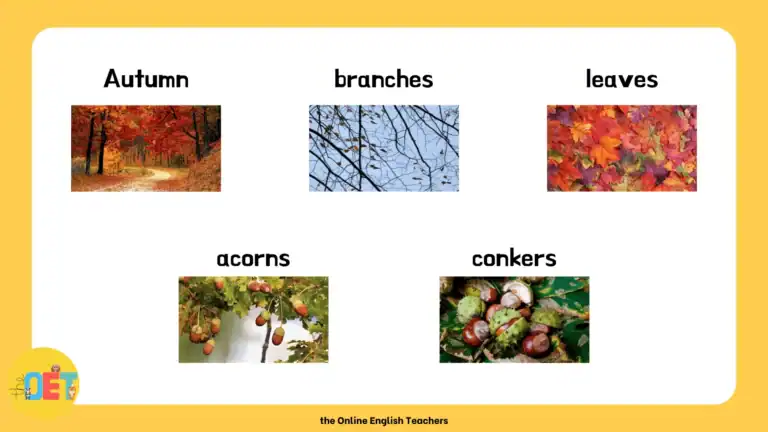
Use this list while you watch to model clear pronunciation and short, useful sentences. Read the word, point to a picture or a real item if you have one, then say the sentence together.
- Autumn: The season after summer
- It is autumn.
- Branches: Parts of a tree where leaves grow
- The leaves fall off the branches.
- Leaves: The flat green parts of a plant or tree
- There are many colourful leaves.
- Acorns: Nuts from oak trees
- The squirrels collect acorns for winter.
- Conkers: Seeds from horse chestnut trees
- I like to collect conkers in autumn.
- Pumpkins: Large orange squashes
- We can pick a pumpkin for Halloween.
- Mushrooms: Fungi that can grow in forests
- I like to make mushroom soup in autumn.
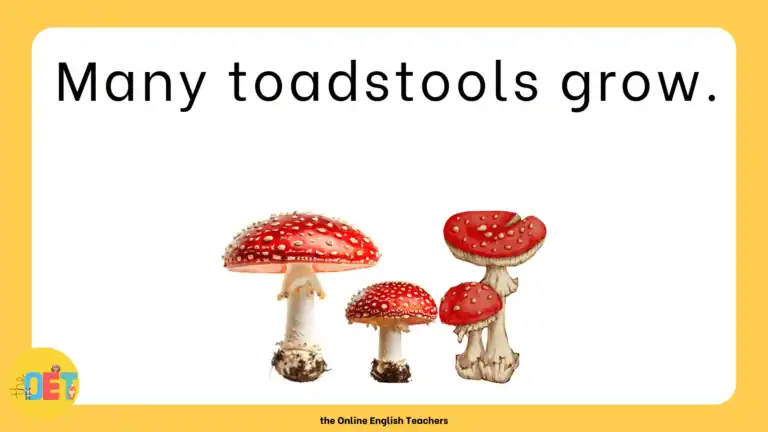
- Toadstools: Bright fungi, often red with white spots
- We can look for toadstools in the forest.
- Berries: Small round fruit on bushes
- The birds eat the red berries.
- Corn: Tall plant with yellow kernels
- We can cook corn and make popcorn.
- Apples: Round fruit, red, green, or yellow
- Apples are delicious.
- Hay: Dried grass used by farmers
- There are many hay bales in the fields.
- Harvest: When farmers gather crops
- The farmers are harvesting the fields.
- Windy: When the wind is strong
- It can be very windy in autumn.
- Squirrel: A small animal with a bushy tail
- The squirrel collects nuts and seeds.
- Hedgehog: A small animal with spines
- The hedgehog looks for a place to sleep.
Try this while you watch
Set your children up for success before you press play. A few simple steps can help your children listen well and feel confident.
- Repeat and point: Say the word, point to the picture on screen, then say it together. Keep it brisk and fun.
- I say, you say: Whisper the word, then say it loudly. Say it slowly, then fast. Varying the voice keeps focus.
- Actions help memory: Leaves blow, squirrels collect, hedgehogs hide. Do the actions as you say the lines.
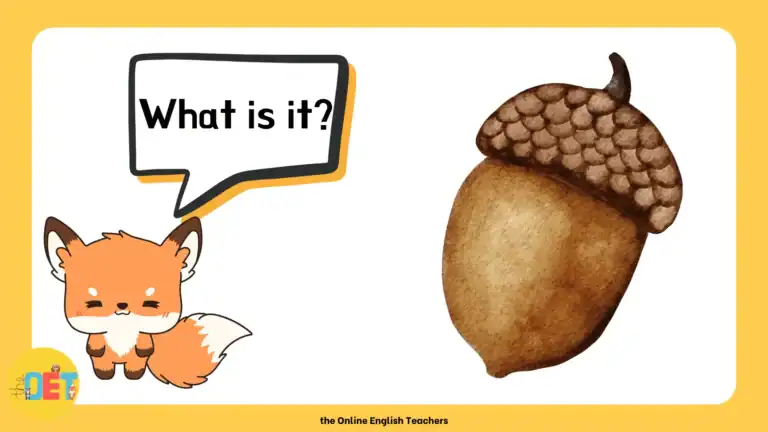
- Pause and practise: When you hear a new word, pause and ask, “What is it?” Offer the sentence frame, “It is a…” or “They are…”.
- Celebrate tiny wins: A thumbs up, a smile, or “Great try!” keeps motivation high.
Keep sessions short, about 10 minutes for younger learners. Little and often is best.
Play the “What is it?” quiz together
The video includes a simple guessing game that you can copy at home. This builds listening, speaking, and confidence.
- Ask, “What is it?” for one item, for example, a pumpkin or an acorn.
- Child answers, “It is a pumpkin.”
- Ask, “What are they?” for groups, for example, berries or leaves.
- Child answers, “They are berries.”
To make it playful:
- Show two or three choices: “Is it an apple, a pumpkin, or an acorn?”
- Hide a picture under a tea towel. Reveal only a small part. Ask the question again.
- Use toys or real objects if you have them. Real items make the language stick.
You can also switch roles. Encourage your children to ask you, “What is it?” You answer with full sentences to model strong language.
Model simple autumn sentences
Short-patterned sentences make speaking feel easy. Try these lines from the lesson. Add actions for fun and memory.
- It is autumn.
- Leaves blow in autumn.
- I can carve a pumpkin.
- The farmer harvests the field.
- Squirrels collect nuts and seeds.
- Many toadstools grow.
- The branches have many conkers.
- The birds eat berries.
- I like to eat red apples.
- Corn grows tall in the field.
- Hedgehogs hide in the leaves.
- There are lots of hay bales.
- It is very windy outside.
- I can pick mushrooms in the forest.
- The animals collect acorns for the winter.
Make it a chant. Say each sentence twice. For example, “Leaves blow in autumn, leaves blow in autumn.” Keep your rhythm steady, clap on key words, and smile as you speak. Your energy sets the tone.
After the video: easy ways to extend learning at home
You do not need a classroom to make language learning rich. Your home, your garden, even your walk to school can bring the words to life.
1) Nature walk word hunt
- Take a bag and look for safe items: leaves, conkers, small sticks.
- Say, “I can see a leaf. The leaf is red,” or “These are leaves. They are yellow.”
- Try a tally chart on a small notepad. Count how many acorns, leaves, or berries you spot.
2) Kitchen conversations
- Make simple popcorn together. Say, “We can cook corn. We can make popcorn.”
- Cut apples for a snack. Talk about colour, size, and taste. “This apple is green. It is sweet.”
- Compare textures: smooth conker versus rough bark, soft hay in a picture versus crunchy leaves underfoot.
3) Craft time
- Leaf rubbings with crayons. Label your picture with words: leaves, branch, autumn.
- Paper pumpkin faces. Use “I can” sentences: “I can carve a pumpkin,” or “I can cut eyes.”
- Conker threading for fine motor skills, with adult help. Count together as you thread.
4) Mini-book story
Fold a sheet of paper into a tiny book. On each page, draw one item and write one short sentence. For example:
- Page 1: Autumn. It is autumn.
- Page 2: Leaves. Leaves blow.
- Page 3: Squirrel. The squirrel finds acorns.
- Page 4: Hedgehog. The hedgehog hides.
Read the book each night for a week. Repetition builds fluency.
5) Sorting and grammar games
- Sort singular and plural: leaf or leaves, berry or berries, pumpkin or pumpkins.
- Match sentence starters and endings: “The birds…” with “…eat berries.”
- Build questions: Put “What is it?” and “What are they?” on cards. Hold up a card and let your children ask or answer quickly.
6) Little science moments
- Wind test at the window: Is it windy today? Hold a leaf by the handle of a wooden spoon and watch. “It is windy,” or “It is not windy.”
- Seed talk: Which animals collect seeds? “Squirrels collect nuts and seeds.” Show pictures to support the words.
7) Spot-the-difference fun
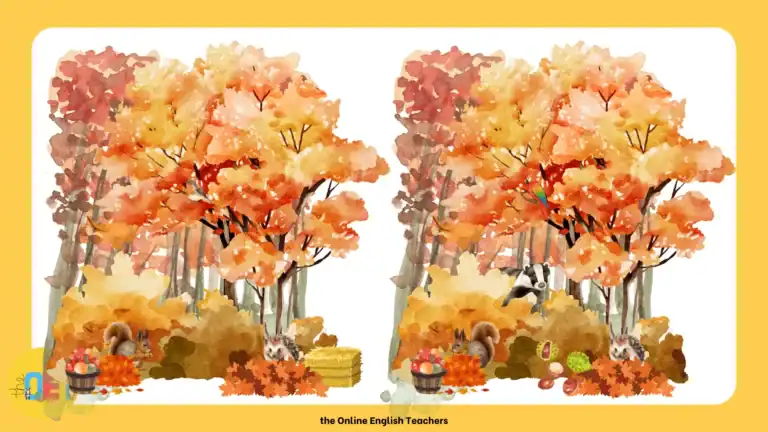
The video ends with two autumn scenes and five differences. Pause the screen and find them together. Prompt with, “I can see…” and “There is…” to build descriptive language. You can also draw your own two pictures at home. Keep one small detail different, like the number of berries or a missing acorn.
Support bilingual learning
If your home language is not English, use it as a bridge. It helps understanding and reduces stress.
- Preview new words in your home language, then say them in English.
- Create two-sided flashcards, your home language on one side, English on the other.
- Talk about similar words. For example, apple may sound close to the word you use at home.
- Encourage code-switching during play. Your children can mix languages at first. Over time, nudge toward full English sentences.
Common pronunciation and meaning tips
A few words in this set can be tricky. Here are quick fixes you can use on the go.
- Squirrel: Say it slowly together, “skwih-rul.” Keep it light, and praise effort.
- Hedgehog: Two clear parts, “hedge” and “hog.” Tap your fingers twice as you say it.
- Conkers, not conquers: The seed from a horse chestnut tree is a conker. The verb “conquer” means to win, which is different.
- Leaves and leaf: Leaf is one, leaves are more than one. Hold one leaf, then a handful to show the change.
- Toadstools: “oa” as in coat and boat”. Safety reminder – don’t let your children touch wild fungi, as it is poisonous.
- Corn and popcorn: Corn is the plant and kernels, popcorn is the snack you make from corn.
Short, calm correction works best. Repeat the word correctly, smile, and move on.
Make practice playful with a follow-up game
Once your children know the words, a quick picture-guessing game helps to solidify them. You can play with your own doodles or with a second short video. Try this simple activity next time for a burst of fun speaking practice: Autumn vocabulary guessing game for kids. Play, pause, and encourage your children to answer in full sentences.
If you would like printable flashcards and a poster to support this topic, you can find them in this free library of resources: Autumn flashcards and poster in the Free Resource Library. Print, cut, and use them for matching, memory games, and quick reviews after dinner.
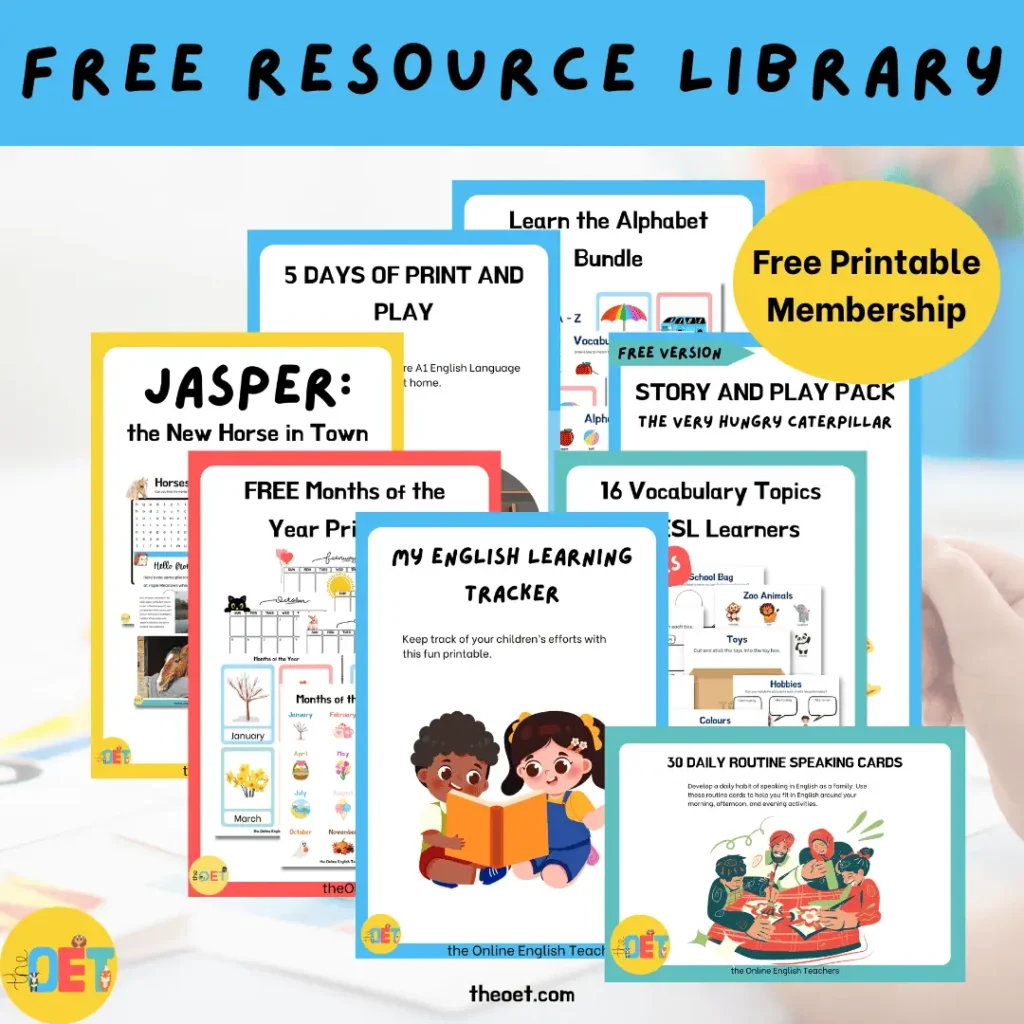
Join the FREE Resource Library
Looking for FREE quality printables, templates, and guides to help you teach your kids ESL at home?
Join theOET’s FREE Membership and gain access to 10s of resources designed by a qualified teacher to help your family learn English at home.
New resources are added every month. Save time, money, and stress with pre-made educational printables and guides.
A simple routine you can repeat each week
You do not need new activities every day. A steady rhythm helps build confidence and sets up expectations.
1. Warm up, 2 minutes
Say five words from the list. Quick repeat-after-me.
2. Watch and speak, 5 minutes
Play the video. Pause after each word. Ask, “What is it?” Encourage full sentence answers.
3. Sentence of the day, 2 minutes
Choose one line, for example, “The birds eat berries.” Chant and act it out together.
4. Quick game, 3 minutes
Hide a picture under a cloth. Your children ask, “What is it?” Give two clues before the reveal.
5. Review, 1 minute
End with, “What was your favourite word today?” Celebrate the answer.
This tiny routine fits into busy family life, keeps things light, and still makes steady progress.
Why this approach works
Children learn language through sound, movement, and meaning. When you pair a word with an action, a picture, and a short sentence, you create strong links in the brain. Repeating key patterns, like “It is…” and “They are…”, helps your children speak without stopping to think too hard. The topic of autumn is also highly visual, which makes it easier to remember.
Keep it safe and seasonal
A quick safety note as you explore. Do not pick or eat wild mushrooms or toadstools, as many are unsafe. Only handle conkers that have fallen, and watch for traffic near roads when collecting leaves or acorns. If you visit a farm, follow signs and stay behind fences. With simple care, you can enjoy the best of the season while learning together.
Autumn is full of colour, texture, and easy talking points, which makes it perfect for growing your children’s English. Start with the words, build short patterned sentences, and keep practice fun with quick games and real-life activities.
Watch this lesson, Autumn vocabulary for kids, then play the guessing game, and finish with a short walk or craft. Small daily steps add up, and your children will soon use their new words with pride. Most of all, make space to smile and learn through play as a family.
Join the FREE Resource Library
Looking for FREE quality printables, templates, and guides to help you teach your kids ESL at home?
Join theOET’s FREE Membership and gain access to 10s of resources designed by a qualified teacher to help your family learn English at home.
New resources are added every month. Save time, money, and stress with pre-made educational printables and guides.