
If you want your children to feel confident when they read, simple phonics sentences for beginners are a powerful place to start. Short, clear sentences let your children use the sounds they already know, hear themselves succeed, and enjoy the story at the same time.
This phonics video from me gives you a complete, ready-made practice session with Phase 2 phonics sentences, gentle music, and lots of praise. You can watch it as a family, pause it, and turn it into a daily reading routine.
Relax and learn practice early reading skills together as a family with these done-for-you phonics sentences for beginners.
How the Video Helps Your Children Read Full Sentences
The whole aim of the video is to help your children practise reading full sentences with phonics sounds in a calm, supportive way. It focuses on Phase 2 phonics, so you see short words like cat, dog, sit, run, nap, and so on.
Each sentence is read three times in the same pattern:
- Step 1: Listen first
The teacher reads the sentence at normal speed. Your children listen and look at the words and picture. - Step 2: Read together, slowly
The teacher reads the sentence again, more slowly, and invites your children to join in. - Step 3: Read alone
There is a short pause where it is your children’s turn to read the sentence independently.
You hear encouraging phrases all the way through, such as:
Try your best.
On the screen, each word is highlighted as it is read. This helps your children track from left to right and notice that every spoken word matches a written word.
There are also cute pictures to match each sentence. For example:
- A cat on a log
- A dog in the mud
- A ladybird sitting on a puppy’s nose
These images help children understand what they are reading and give you an easy way to talk about the sentence after they read it.
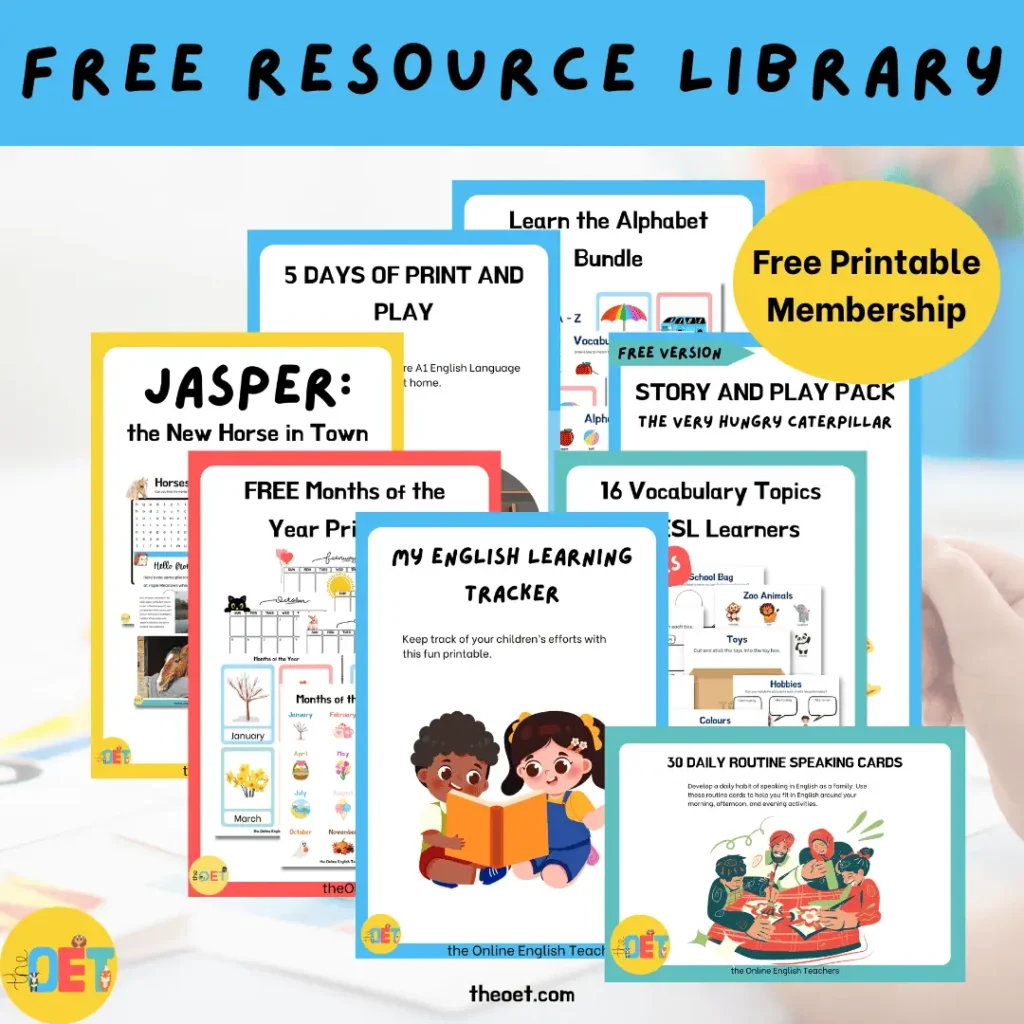
Join the FREE Resource Library
Looking for FREE quality printables, templates, and guides to help you teach your kids ESL at home?
Join theOET’s FREE Membership and gain access to 10s of resources designed by a qualified teacher to help your family learn English at home.
New resources are added every month. Save time, money, and stress with pre-made educational printables and guides.
Why This Kind Of Phonics Practice Works
Builds strong reading skills
The three-step pattern in the video is simple but very effective. Your children:
- Hear the sentence first.
- Practise with support while the teacher reads slowly.
- Try alone once they feel ready.
This pattern supports several key skills:
- Listening to the full sentence
- Blending sounds to read each word
- Reading with a natural rhythm
- Building confidence to read without help
I also try to provide lots of positive feedback to encourage your children further. You hear phrases like:
- Fantastic. Well done.
- Great reading.
- You’re doing so well.
- Super reading.
- You are acing these sentences.
- You are awesome.
For many children, especially beginners or shy readers, this kind of praise makes a big difference. They feel safe to try, even if they make mistakes.
Fun details keep children engaged
The video uses gentle background music and short breaks between sentences so your children do not feel rushed. This helps them reset before the next sentence.
The sentences themselves are simple, but often a bit funny or playful:
- Oh no, silly dog when the dog is in the mud
- What a naughty cat when the cat takes some ham
- Uh-oh when something surprising happens
There is also a sense of progress. I make note of what has been accomplished:
- You’ve read three sentences now.
- Wow, you’re getting good at these sentences.
This lets your children feel that they are moving forward, not just repeating the same thing.

Perfect for ESL families and early readers
If your family is learning English as a second language, this video fits very well. The sentences:
- Use clear, everyday vocabulary
- Focus on Phase 2 phonics sounds
- Repeat key patterns, such as I can… or The dog can…
You can combine this video with the Phase 2 phonics sounds playlist from the same channel. The playlist helps your children learn each sound and blend simple words, then this sentence video lets them use those skills in real reading.
Step-By-Step Guide To The Phonics Sentences In The Video
You can use the sentences from the video in many ways. You might watch and read along, pause and repeat tricky parts, or write some of the sentences on paper to keep practising.
Here is a guide to the sentences and ideas for how to use them at home.
Short and simple sentences
These first sentences are very short and use common Phase 2 words. They are perfect if your children are just starting with phonics sentences for beginners.
| Sentence | Picture idea | Home practice tip |
|---|---|---|
| I sit on the mat. | Child sitting on a mat | Put a towel on the floor and let your children act out the line. |
| A cat is on a log. | Cat sitting on a log | Ask, “Can you point to the cat? Can you point to the log?” |
| A man had a map. | Man holding a map | Give your children a “map” (perhaps one they have made) and let them pretend, too. |
| The dog got a pat. | Dog being patted | Gently pat a toy dog or soft toy as you read together. |
| A cat can hiss. | Cat hissing | Talk about how a cat sounds and whisper “hiss” together. |
| Sam is in a den. | Child in a den or tent | Build a small den with a blanket and read the sentence inside. |
| Tom can hop on the log. | Boy hopping on a log | Let your children hop in place as they say the word hop. |
| A pup can run and sit. | Puppy running then sitting | Ask your children to “run” on the spot, then “sit” when you read. |
| A kid can tap a cup. | Child tapping a cup | Use a plastic cup and let your child tap in time with the words. |
| A man can dig. | Man digging | Pretend to dig with your hands while reading the sentence. |
These quick actions keep the practice light and active, which is very helpful if you have more than one child. Different children can take turns acting and reading.

Longer sentences for a gentle challenge
Once your children are happy with the short sentences, you hear slightly longer ones that still use easy words.
Sentence 11: A cat sat on a big red bag.
The teacher points out that this is a longer sentence. You can slow down and help your children spot the extra words: big and red. Ask them to find the describing words and say, “What kind of bag is it?”
Sentence 12: A dog is in the mud.
Here you hear, Oh no, silly dog. This is a good chance to talk about the picture. You might ask, “Is the dog clean or dirty? What happened?” This builds understanding as well as reading.
Sentence 13: A bug is on a pup.
The picture shows a ladybird on the puppy’s nose. After your children read, you can ask, “Where is the bug? On the leg, or on the nose?” This encourages them to connect words with details in the picture.
Sentence 14: A cat got a bit of ham.
You hear the teacher say, What a naughty cat. You could ask, “Whose ham is it?” and let your children make up a short answer.
Sentence 15: A man had a hot cup.
This sentence is still simple, but the word hot lets you talk about safety. You might say, “The cup is hot. Should we touch it?” This helps language and thinking at the same time.
Multi-sentence challenges
Near the end of the video, your children read sets of short sentences that go together. These are great for building fluency and spotting small changes.
- I can sit. I can hop. I can run.
You can have your children act out each action. One child sits, one hops, one runs on the spot. - The cat can sit. The cat can nap.
Ask your children what is different between the two sentences. Only one word changes, which is perfect for building careful reading. - The dog can dig. The dog can run.
Again, only the verb changes. You might say, “Show me dig. Now show me run.” - A kid can hug a dog.
This one is lovely for talking about kindness and gentle touch. If you have a pet, you can show how to hug softly. - I am on the mat. I am in the hut.
These are the final sentences. They highlight the difference between on and in, which is very useful for ESL learners. You can use a box and a toy to show on the box and in the box.
You can copy any of these sentences onto paper and keep them in a small “sentence box” for quick daily practice.

How To Use This Video With Your Family
A simple routine you can follow
You do not need to use the video in a perfect way, a simple, repeatable routine is enough. Here is an idea of how to use it:
- First watch
Play the video all the way through while your children just listen and watch. No pressure to read. - Second watch with joining in
This time, ask everyone to join the teacher in the “read together” part. You might say, “Let’s all read with the teacher when it is slow.” - Pause for turns
On another day, pause before the “your turn” part. Ask one child to read a sentence aloud, then let a different child read the same sentence. This way, siblings can support each other. - Repeat across the week
Using the same video several times helps children feel safe and successful. They know what is coming, so they can focus on reading more smoothly.
If you like, you can copy the teacher’s praise. Simple lines such as “Great reading”, “You tried your best”, and “You did it” help a lot, especially when children are learning English.
Follow-up activities to build fluency at home
After watching the video, you can use the same phonics sentences for beginners in short family activities. Here are some ideas.
- Sentence of the day
Write one sentence from the video on a card. Put it on the fridge. Ask each child to read it aloud once in the morning and once in the evening. - Act and read
Pick action sentences such as I can hop or The dog can run. One child reads while another acts. Then they swap roles. - Word jumble
Write one sentence on small pieces of paper, one word per piece. Mix them up and ask your children to put them back in order. Say the sentence together at the end. - Change one word
Start with a sentence from the video, such as A cat is on a log. Change one word, for example to A dog is on a log. Ask, “What did we change?” This supports both speaking and listening. - Draw the sentence
Let your children pick a favourite sentence and draw it. Under the picture, write the sentence and read it together. For more advanced children, leave a gap for them to write one of the words. - Sibling teacher time
If you have an older child, invite them to be the “teacher”. They read the sentence first, then point to each word while the younger child reads it. This gives both children meaningful practice.
You can keep these activities relaxed and short, around 5 to 10 minutes. Quality matters more than length.

Use free printables and related videos
To support this video, you can also use:
- The Phase 2 phonics sounds playlist helps your children review each sound and blend simple words.
- The Free Resource Library for printables from the Online English Teachers, where you can download phonics and reading materials to use at home.
You might choose one Phase 2 sound to review from the playlist, then read a matching sentence from the video that includes that sound. This kind of link between sound, word, and sentence strengthens your children’s reading.
Join the FREE Resource Library
Looking for FREE quality printables, templates, and guides to help you teach your kids ESL at home?
Join theOET’s FREE Membership and gain access to 10s of resources designed by a qualified teacher to help your family learn English at home.
New resources are added every month. Save time, money, and stress with pre-made educational printables and guides.
When you use this video with your family, you are giving your children a safe, friendly way to practise phonics sentences for beginners and feel proud of what they can do. The clear routine, highlighted words, and gentle praise all support stronger reading and better focus.
You can build on the video with simple home activities, shared reading, and quick games. Over time, you will start to hear smoother reading, clearer speech, and more confident voices.
As I say at the end:
Give yourself a clap. Yay! You read so many sentences.
You and your children deserve that clap, too. Keep the practice light, keep it regular, and enjoy learning English together as a family.


Related Posts
- A Guide to Helping Your Children Learn Phonics Sounds
- Phase 2 Phonics Sounds for Kids: Supporting Early Reading Skills
- Online English Stories for Kids: A Friendly Guide for ESL Families at Home
- Best Storybooks for Young ESL Learners at Home (Ages 3–8)
- How to Use Bedtime Stories to Teach English at Home

