

Are you teaching English at home and short on time? You’re in the right place. For families with children aged 3 to 8, the best storybooks for young ESL Learners is your friendly guide to making English learning easy, fun, and stress-free.
Storybooks are one of the most powerful tools for language learning. They build listening, speaking, vocabulary, phonics, and confidence—all through play and repetition. With the right books, your child gets strong language patterns, clear pictures, and familiar phrases that are easy to join in with.
In this guide, you’ll find:
- A simple framework for choosing great ESL storybooks
- A handpicked list of 12 picture books with summaries and home tips
- A repeatable routine for before, during, and after reading
- Budget-friendly ways to access storybooks today
Ten minutes a day really can make a difference in your children’s English growth and confidence.
Disclaimer: This post contains affiliate links. If you choose to make a purchase using these links, I may earn a small commission at no additional cost to you. You can view the full affiliate disclosure here.
What Makes a Great ESL Storybook for Ages 3–8
You don’t need a teaching degree to choose the right books. Use this quick checklist to spot a good ESL storybook in seconds:
- Repetition and rhyme: Repeated lines help new words stick. Rhymes make English sounds easier to predict and remember.
- Strong pictures: Clear, simple illustrations support understanding without translation.
- Simple grammar patterns: Present simple tense and short questions (what, where) work best for beginners.
- Phonics-friendly text: Predictable patterns and high-frequency words help children decode independently.
- Inclusive, engaging themes: Familiar topics, feelings, and diverse characters keep motivation high.
When stories repeat lines like “I see a…” or “We can’t go over it, we can’t go under it,” children relax, listen closely, and join in naturally. That sense of success is what builds confidence, and confidence leads to fluency.

Unlimited Access to Educational Story and Play Activity Packs for Your Children (Pre A1-A1)
Join the Print and Play Club and gain access to all theOET’s educational Story and Play Activity Packs. Each pack offers 7 days worth of printable activities your children can complete surrounding a popular children’s book. From core ESL skills to learning through play and games, each pack focuses on helping your children learn English through stories and play.
Repetition and Rhyme Help Words Stick
Repetition makes English predictable and comforting. Choose stories with recurring phrases and patterns that invite your children to speak along.
Try this at home:
- Echo reading: You read a line, your child repeats it.
- Choral reading: Read repeated lines together.
- Add gestures: Act out verbs like run, jump, or see.
Example:
- Adult: “I see a red bird.”
- Child: “I see a red bird.”
Strong Pictures Support Meaning
Illustrations help our children gain context for unfamiliar content. Clear, uncluttered pictures help children understand new words without needing translations.
Try a quick picture walk:
- Point and name objects, actions, or colours.
- Ask, “What is it?” “What colour?” “How many?”
- Pause so your children can answer first, then echo and expand.
Simple Grammar You Can Echo
Choose stories with natural, everyday language that children can copy.
Look for:
- Present simple sentences (I like apples. The tiger drinks tea.)
- Short questions (Where is Spot? What do you see?)
- Common verbs (see, go, like, have, eat, make, say)
Model short and full answers:
- What is it? — A cat.
- What is it? — It is a cat.
- Is he under the bed? — No, it is not.
These simple sentence patterns help children learn grammar through use, not memorisation.
Phonics-Friendly Text for Beginners
Early readers benefit from stories with clear spelling patterns and simple sound links.
Look for:
- CVC words (cat, dog, cup)
- Simple blends (frog, clap)
- Sight words (I, you, see, go)
Quick phonics games:
- “I spy something that starts with /b/.”
- Clap syllables in longer words (ca-ter-pil-lar).
- Find rhyming words (snake, cake, lake).
Playful repetition helps phonics feel natural instead of forced.

Inclusive, Engaging Themes Keep Motivation High
Children love stories they can relate to. Choose books with diverse families, familiar routines, and universal emotions like bravery, friendship, and kindness. When children see themselves in stories or discover something new, they’re more likely to listen, respond, and talk about it afterwards.
Motivation matters more than difficulty. When children enjoy what they’re reading, English learning follows naturally.
Top 12 Best Storybooks for Young ESL Learners (Ages 3–8)
Each of these books builds English through rhythm, repetition, and joy. Here’s what each story is about and how it supports your children’s language development.
Brown Bear, Brown Bear, What Do You See? (Bill Martin Jr. & Eric Carle)
This gentle, rhythmic story introduces a parade of colourful animals through a simple repeated question: “What do you see?” Children quickly pick up the pattern and begin predicting the next line. It’s perfect for introducing colours, animals, and the rhythm of English sentences.
- Best age: 3–6
- Targets: Colours, animals, I see… question-and-answer pattern
- Tip: Point to each animal and ask, “What do you see?” Echo together with an action for the word see.
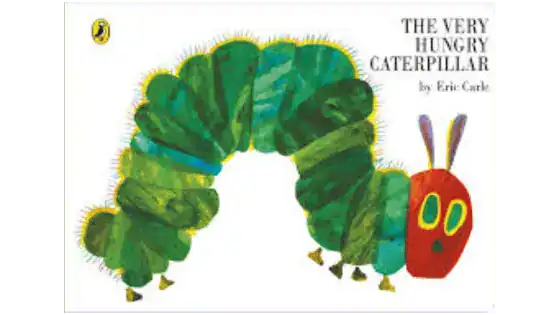
The Very Hungry Caterpillar (Eric Carle)
A tiny caterpillar eats through different foods each day before transforming into a butterfly. The predictable rhythm and simple storyline make it perfect for practising days of the week, counting, and food vocabulary. The cheerful artwork captures attention while the language patterns encourage speaking confidence.
- Best age: 3–7
- Targets: Days of the week, food words, counting, simple I eat… sentences
- Tip: Use snacks or pictures to retell: “I eat grapes. I am hungry.”
Dear Zoo (Rod Campbell)
A child writes to the zoo asking for a pet. One by one, the zoo sends animals, each too big, too tall, too fierce, until the perfect one arrives. The story’s rhythm and surprises help children practise adjectives, opposites, and simple sentence patterns.
- Best age: 3–6
- Targets: Animals, adjectives, opposites, It is too… structure
- Tip: Hide toy animals in small boxes or bags. Describe before opening: “It is too big!”
Where’s Spot? (Eric Hill)
In this story, Spot the puppy is hiding, and young readers search behind flaps to find him. The repetitive question-and-answer format makes it ideal for learning prepositions like in, on, under, and behind. It’s an engaging introduction to simple questions and short replies.
- Best age: 3–5
- Targets: Prepositions, short questions, yes/no answers
- Tip: Play a hide-and-seek game with a soft toy. “Is Spot under the sofa?”
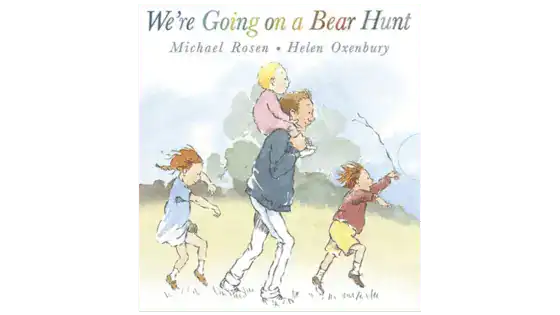
We’re Going on a Bear Hunt (Michael Rosen)
A family goes on an exciting walk through grass, mud, and snow to find a bear, and then races home again! The rhythmic language, repetition, and sound effects make it perfect for acting out. Children learn sequencing words, nature vocabulary, and prepositions while having fun.
- Best age: 3–7
- Targets: Sequencing, prepositions, onomatopoeia, action verbs
- Tip: Act it out with gestures and sound effects, then draw a map together.
Goodnight Moon (Margaret Wise Brown)
This calm, poetic bedtime story gently says goodnight to everything in the room. Its simple rhythm and familiar objects make it perfect for bedtime vocabulary and daily routines. The repetition builds comfort and rhythm awareness in English.
- Best age: 3–6
- Targets: Everyday objects, repetition, bedtime language
- Tip: Use it in your own bedtime routine: “Goodnight, lamp. Goodnight, chair.”
Chicka Chicka Boom Boom (Bill Martin Jr. & John Archambault)
The alphabet climbs a coconut tree in this fun, musical story filled with rhythm and rhyme. It’s excellent for practising letter names, sounds, and early phonics. The catchy beat helps children hear patterns in English while connecting letters to sounds.
- Best age: 4–7
- Targets: Alphabet recognition, rhythm, phonics, letter sounds
- Tip: Tap the rhythm together and say, “A says /a/.” Make a paper coconut tree for letter cards.
The Gruffalo (Julia Donaldson)
A clever mouse makes up a story about a monster, the Gruffalo, to scare away other animals, only to meet the real creature! The rhyme, humour, and clever storytelling make it perfect for practising adjectives, body parts, and describing words.
- Best age: 5–8
- Targets: Rhyme, adjectives, body parts, story structure
- Tip: Create a character chart (mouse, fox, owl, snake, Gruffalo) and act out the dialogue.
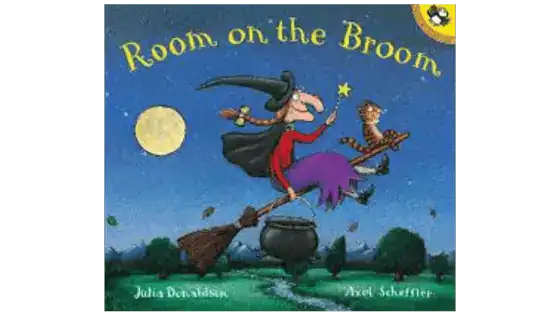
Room on the Broom (Julia Donaldson)
A kind witch drops her belongings, picks up new friends, and faces a dragon! The story has a central theme of teamwork and clever thinking. The story’s strong rhyme and sequence make it great for practising order words like First, Next, Then, Finally. It also teaches kindness and cooperation.
- Best age: 5–8
- Targets: Rhyme, sequencing, verbs (drop, find, fly, help), teamwork
- Tip: Retell the story using picture cards to show who joins the broom.
Handa’s Surprise (Eileen Browne)
Set in a Kenyan village, Handa carries a basket of fruit to her friend, but along the way, sneaky animals take pieces without her noticing! The story builds fruit and animal vocabulary while introducing another culture. It encourages curiosity, observation, and discussion.
- Best age: 4–8
- Targets: Fruit names, animals, verbs (carry, take, give), cultural awareness
- Tip: Taste fruits together. Say, “I like mango. I don’t like avocado.”
Giraffes Can’t Dance (Giles Andreae)
Gerald the giraffe feels left out at a jungle dance until he finds his own rhythm. The rhyming text and positive message make it wonderful for building emotional language and self-confidence. It’s great for verbs, adverbs, and I can… sentences.
- Best age: 5–8
- Targets: Feelings, verbs, adverbs, positive self-talk
- Tip: Make a “Feelings and Actions” chart. “I feel happy. I can dance slowly.”
The Tiger Who Came to Tea (Judith Kerr)
When a tiger unexpectedly visits Sophie and her mum, he eats all their food and turns an ordinary day into something exciting. The story’s familiar home setting introduces everyday nouns, polite language, and simple past tense verbs in context.
- Best age: 4–8
- Targets: Everyday objects, polite phrases, past tense verbs
- Tip: Host a pretend tea party. Practise “Please,” “Thank you,” and “He ate… He drank…”
Meg and Mog (Helen Nicoll & Jan Pieńkowski)
Meg the witch and her cat Mog try a spell that doesn’t go quite as planned! The bright illustrations and playful sound words make this story perfect for early readers. It supports sequencing, onomatopoeia, and days of the week vocabulary.
- Best age: 4–7
- Targets: Days, sequencing, sound words, simple sentences
- Tip: Draw a three-panel comic to retell: “I mix… I say… It goes…”
Unlimited Access to Educational Story and Play Activity Packs for Your Children (Pre A1-A1)
Join the Print and Play Club and gain access to all theOET’s educational Story and Play Activity Packs. Each pack offers 7 days worth of printable activities your children can complete surrounding a popular children’s book. From core ESL skills to learning through play and games, each pack focuses on helping your children learn English through stories and play.
How to Read These Books at Home for Faster ESL Progress
Short, consistent reading routines work best. Here’s a simple pattern to follow:
- Before reading – picture walk and key words:
- Preview 3–5 new words (e.g., bear, grass, river).
- Ask simple questions: “What can you see?” “What colour?”
- Guess what might happen next.
- During reading – echo, choral, and actions:
- Read a line, let your child echo.
- Read repeated lines together.
- Add actions for verbs like go, see, eat, fly.
- After reading – quick retell and games:
- Sequence 3–4 pictures with First, Next, Then, Finally.
- Play a quick game of I spy or Where is the…?
- Extend learning – songs, crafts, and phonics:
- The Very Hungry Caterpillar: make a caterpillar headband.
- Chicka Chicka Boom Boom: build a letter tree.
- Handa’s Surprise: make a fruit tasting chart.
- The Gruffalo: act with character masks.
Small, joyful repetition is what builds real progress in English.
Budget-Friendly Ways to Find Storybooks and Read-Alouds
You can build an amazing home library on any budget. Make sure to sign up to your local library and utilise everything it has to offer:
- Reserve popular titles in advance.
- Look for bilingual or dual-text shelves.
- Borrow 5 books a week and renew favourites for fluency.
If you don’t have easy access to a physical library of books, why not try audiobooks and read-alouds:
- Listen together to model pronunciation and rhythm.
- Turn on captions for visual support.
- Pause to echo lines or repeat favourite phrases.
- Choose official channels and trusted narrators.
For extra educational activities, you can easily make your own DIY resources at home with minimal costs involved and can be made quickly, perfect if you are limited on time:
- Make word cards and puppets from paper.
- Cut sequencing pictures for quick retells.
- Store props in labelled zip bags to reuse.
Here is a quick start checklist to help you use your first storybook for young ESL learners:
- Pick one book.
- Place a library hold or find an audiobook.
- Prepare 3 words and 3 questions.
- Plan a 10-minute reading tonight.
- End with a fun 2-minute game.
You can teach English at home with just a few storybooks, steady routines, and lots of smiles. These books combine repetition, rhyme, and rich illustrations to make English learning fun and natural for your children.
Start small. Choose one story and read for ten minutes tonight. Over time, those small, joyful moments will build your children’s confidence. Bookmark this list, check out a few titles from your library, and enjoy your English storytime together.
If you are looking for ready-to-use printables that help extend your children’s learning alongside reading these stories, then take a look at the Print and Play Club:
Unlimited Access to Educational Story and Play Activity Packs for Your Children (Pre A1-A1)
Join the Print and Play Club and gain access to all theOET’s educational Story and Play Activity Packs. Each pack offers 7 days worth of printable activities your children can complete surrounding a popular children’s book. From core ESL skills to learning through play and games, each pack focuses on helping your children learn English through stories and play.
Related Posts
- 12 Classic Fairy Tales for English Language Learners
- Top 11 Fable Stories for Kids to Build English Language Skills
- 12 Traditional Folktales from Around the World
- 20 Top Tips to Effectively Use Storybooks to Teach English at Home
- Bilingual Storytime: Tips for Using Dual-Language Books to Learn English

