
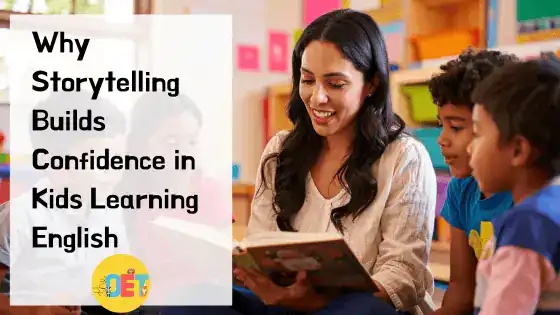
Story-telling offers a natural way for children to engage with a new language. Reading stories to our children not only strengthens the bond we have together but also exposes them to new language, ideas, and cultures.
When we read stories to our children, their confidence in English grows. As they watch and listen to you read English stories, they repeat words or phrases after you, wanting to join in with the activity.
By making storytelling a part of your everyday routine and an exciting activity, your children will be drawn to participate and get involved.
In this post, I’ll share why storytelling builds confidence in kids learning English, as well as offer you a range of activities you can easily implement at home. By implementing regular storytelling at home with your children, you’ll soon see a difference in their self-confidence, leading to increased active participation.
Key Takeaway: Storytelling builds confidence in kids as it offers a way of teaching children English with a relaxed, low-pressured activity. Reading stories offers a natural method of learning a new language as your children are exposed to new vocabulary, grammar rules, and sentence structures. Stories can also easily be expanded upon with a range of multisensory and hands-on activities that will engage your children’s attention, leading to increased participation and growth.
Why Storytelling Builds Confidence in Kids
Stories feel safe as they are familiar and something that they’ve been exposed to most of their life. Children know what to expect with a story, familiar storylines, patterns, and layouts. This lower pressure helps them try English, even when the words are new. When children relax, they speak more, and that extra practice leads to better language skills.
Often, stories incorporate lots of repetition and rhymes. This helps encourage children to be involved with the story, repeating the lines together, e.g. “I’ll huff and I’ll puff and I’ll blow your house down” from The Three Little Pigs.
As children repeat these lines, they practice more, and their confidence grows.
Storytelling offers:
- Lower stress: Playful scenes and laughter reduce fear of mistakes.
- Built-in repetition: Repeated lines and patterns make new English feel familiar.
- Real purpose: Characters have goals, so children want to speak.
- Social support: Siblings and parents join, which makes speaking less scary.

Play Removes Fear When Learning
Play can have a really positive impact on how your children see learning. When you use silly voices, actions, and sound effects, your children see English as a game. Their anxiety and self-consciousness are lower, leading to increased participation without the fear of “what if I get it wrong?”
Try a quick mini example. Use a lion voice for a brave line: I am brave, I can roar. Add a tiny action, a big chest and a soft roar. You’ll soon see your children try to mimic you and join in.
Story Patterns Increase Predictability
Predictable patterns reduce the mental load on your children. Children can predict what’s coming next and feel more comfortable with the story, taking in more every time it’s reread.
Focusing in the beginning on stories that use simple language, repeated sentences, or lots of onomatopoeia (e.g. bang, crash, drop, huff), will encourage your children to participate as the story being read is at an appropriate level.
Repetition is key to building your children’s memory and speed. When a child says the same line with small changes, their brain connects what they already know, making it easier to learn new content following the same pattern. An example of this could be from “Goldilocks and the Three Bears”. When Goldilocks is in their home, she goes through their porridge, chairs, and beds. The sentence frames are the same:
- This porridge is too hot. This porridge is too cold. This porridge is just right.
- This chair is too hard. This chair is too soft. This chair is just right.
- This bed is too big. This bed is too bouncy. This bed is just right.
Here, your children grow in confidence after they hear the first two examples, as they can predict what will happen next. So not only does it reaffirm language they’ve already been exposed to, but it helps them connect with new vocabulary, leading to stronger retention.
Characters Give Children A Voice.
During storytelling, pretending to be a character from the story can help children feel more confident speaking up. When your children speak as the explorer, the chef, or the robot, they step into a different role that isn’t personal, providing a safe way to explore English.
Naturally Develop Vocabulary, Grammar, and Pronunciation Through Storytelling
Reading stories with your children helps expose them to new vocabulary words, sentence structures, and grammar rules. If you read stories aloud yourself, or listen along to read-alouds on YouTube or Podcasts, it also supports exposure to correct pronunciation.
This leads to an opportunity for children to learn English in a more natural way. Rather than teaching them grammatical rules via textbooks and formal learning methods that don’t always engage our children. Stories demonstrate accurate usage and provide a range of examples that will help your children develop their English understanding.
More often than not, this method is much more effective and enjoyable for our children vs. working through one textbook exercise after another.
Content that is covered through the story can always be recapped afterwards through role-play, expressive story-building printables, or story-themed crafts.

Easy At-Home Storytelling Ideas Every Family Can Do
You do not need lots of space or expensive tools. What matters is spending quality time together and consistent effort rather than sporadic, lengthy periods of studying. 10-15 minutes of intentional language learning each day is extremely effective:
- Keep it relaxed: Short, intimate sessions are better than long, high-pressured ones.
- Use what you have: Toys, socks, paper bags, and crayons.
- Invite siblings: Give small roles so everyone can join.
Your 10-Minute Daily Story Routine
A consistent routine helps your children know what to expect, helps them make progress, and is much easier to maintain vs. long, ad-hoc sessions.
Follow this simple five-step flow, and keep it flexible.
- Warm up: a sound, chant, or tongue twister, for example, Big brown bear.
- Picture walk: look at the images and guess with simple lines.
- Read or tell: keep it short and lively.
- Child retell: invite one or two lines in their words.
- Praise and one gentle fix: you did great with I can…, try found instead of find.
A key to maintaining a daily routine is to incorporate language learning into the routine you already have:
Does everyone eat breakfast together? Perfect! Sit down and start a morning conversation in English, e.g. did you like the book yesterday? What was it about? Who were the main characters?
Do you drive your kids to school? Super! That offers a few minutes where they can listen to a story read aloud on a podcast.
Do you read a nightly bedtime story? That’s fantastic! Start mixing your book choices. Over time, progress from your native language stories, to bilingual, to 100% English.
Incorporating storytelling into your everyday routine will help it become just another daily habit that’s easy to stick to.
Echo Reading and Choral Speaking Build Courage.
Echo reading is simple and very similar to copy work for writing tasks.
With echo reading, you read a short line, and your children copy. Whereas choral speaking means everyone says the line together.
It’s good to start with choosing just two or three lines with rhythm and rhyme. This will make it easier for your children to join in.
When you incorporate echo reading and choral speaking, it takes the pressure off the individual and becomes a group activity.
Props, Puppets, and Drawings
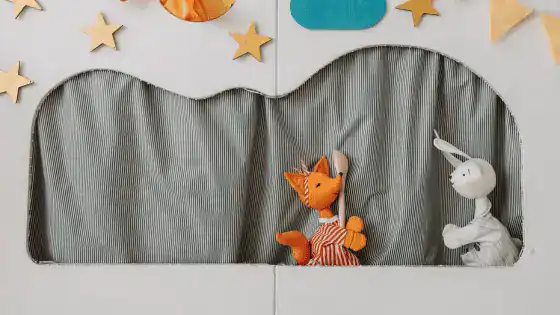
A puppet can speak first, which takes the spotlight off your children. Toys can become characters, or you can make a simple puppet from a sock or paper bag. When you use a puppet or toy, children talk more, as once again, the focus is taken away from them and onto their chosen prop.
Retell, Role Play, and Freeze Frames for Active Speaking
Active speaking involves your children expressing their thoughts and needs clearly. By incorporating active speaking tasks, you’re helping your children build sentences, practice their speaking skills, and assess their comprehension.
Here are a few activity ideas to help:
- Use a simple sequence frame to help retell the story. Incorporate first, then next, and finally.
- Role play with two roles and one prop, like a hat or a spoon.
- For freeze frames, pose a scene in silence, then each person says one line in character.
Simple Story Frames and Prompts
By offering an example sentence frame, you provide your children with support rather than a blank page. Using sentence starters and kind corrections helps build your children’s confidence.
Here are a few sentence frames you could use:
- One day…
- But…
- So…
- Then…
- Now I feel…
Somebody, Wanted, But, So, Then for Quick Retells
SWBST offers a quick retell frame. The model follows using Somebody, Wanted, But, So, Then to help with retelling the story. Here’s an example following the story “Little Red Riding Hood”:
- Somebody: Red.
- Wanted to visit Grandma.
- But the wolf tricked her.
- So, a woodcutter helped.
- Then, she hugged Grandma.
Make prompt cards, one for each part, as a reference and guide for your children to follow.
Story Dice, Picture Cards, and Safe Digital Prompts
These three ideas are great for children who want more hands-on activities.
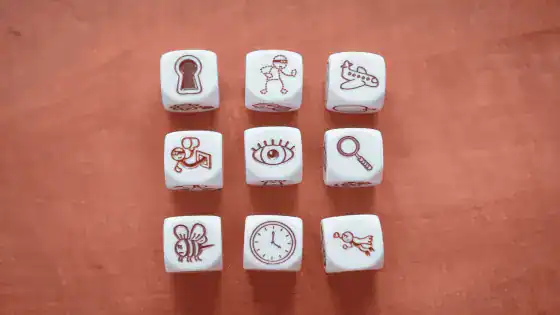
You could build a story dice and draw pictures on each side based on a story. Roll the dice to retell the story in your own words, or answer a question based on each picture.
Cut out magazine images to make your own picture cards. Use these cards like flashcards to practice associated vocabulary words. Or alternatively, mix and match to build a verbal story together.
Or if you try an AI story idea generator, guide it and choose age-safe prompts. The prompts could ask for a setting, a character, and a feeling. Once the AI has created these answers, your children can then build their own story based on them. (When using AI, please monitor your children to ensure the responses generated are safe and age-appropriate.)
Sentence Starters and Constructive Corrections
Children can really struggle when they have to come up with ideas independently, especially younger children. They are more confident and likely to participate when provided with
- I think…
- I feel…
- I want…
- I can…
- Because…
- Next…
Use recast correction. This is where you repeat what your children have said, but with the corrections in place. This helps to minimise lowering their self-esteem through too much error correction and highlighting their mistakes. For example, if your children say “The dog bark”, you would reply with “Yes, the dog barks”.
Make Progress Visible
Children can’t always see the progress that they are making. A great way to help boost their confidence is to keep track of their efforts and improvements. Ensure to break down large goals into smaller, achievable steps. This will help them see the actions they are taking towards their English growth and make it easier for them to understand the progress they are making.
Set Smaller Goals
A goal such as learning 500 vocabulary words can seem quite intimidating, especially for younger children. Breaking down big goals into smaller, micro targets makes them feel much more achievable. It is also more motivating to our children because they will hit milestones a lot faster with a micro target vs. the whole, large goal upfront. This leads to self-recognition and increased confidence.
Use Stickers
Many children respond well to some form of visual recognition. Instead of just offering verbal feedback, set up a sticker chart for each micro goal that feels achievable for your children. Remember to track their effort, not focus solely on their growth.
For example, you could have a table with a square for each sticker. In each square is a small micro goal, e.g.
- Say 10 words in the story.
- Try one new phrase.
- Join the choral line three times.
- Ask one question in character.

Record Audio or Video Diaries
Use your phone to capture storytime once a week. Keep these saved so that you can refer back to them at a later date.
These videos serve as a record to help your children see their progress for themselves. Replay the video to your children 4-6 weeks later. It will feel really rewarding and make all their hard work worthwhile.
Family Storytelling Night
Plan a weekly 15-minute share time that the whole family can get involved with. Rotate the key roles such as narrator, actor, or sound maker. Keep it fun and lighthearted so that your children see it as a game rather than a boring task.
Kids love it when the whole family gets involved in activities. Not only can you be a role model for your children, but it also helps build stronger bonds with one another and makes English learning an enjoyable experience for everyone.
Be Adaptable To Suit Your Family
You might have just one child, or multiple children at different language stages and ages. It is important to be adaptable and alter activities based on what works for your family.
Some children might not be interested in a sticker chart, especially teens. Whereas other children may find watching replays of themselves speaking really valuable.
When it comes to different activities, try to diversify them. Keep your children interested by completing a different activity each day surrounding a particular book. Encourage siblings to support one another. Older siblings can help their younger siblings to understand, whereas younger siblings make learning more playful and relaxed.
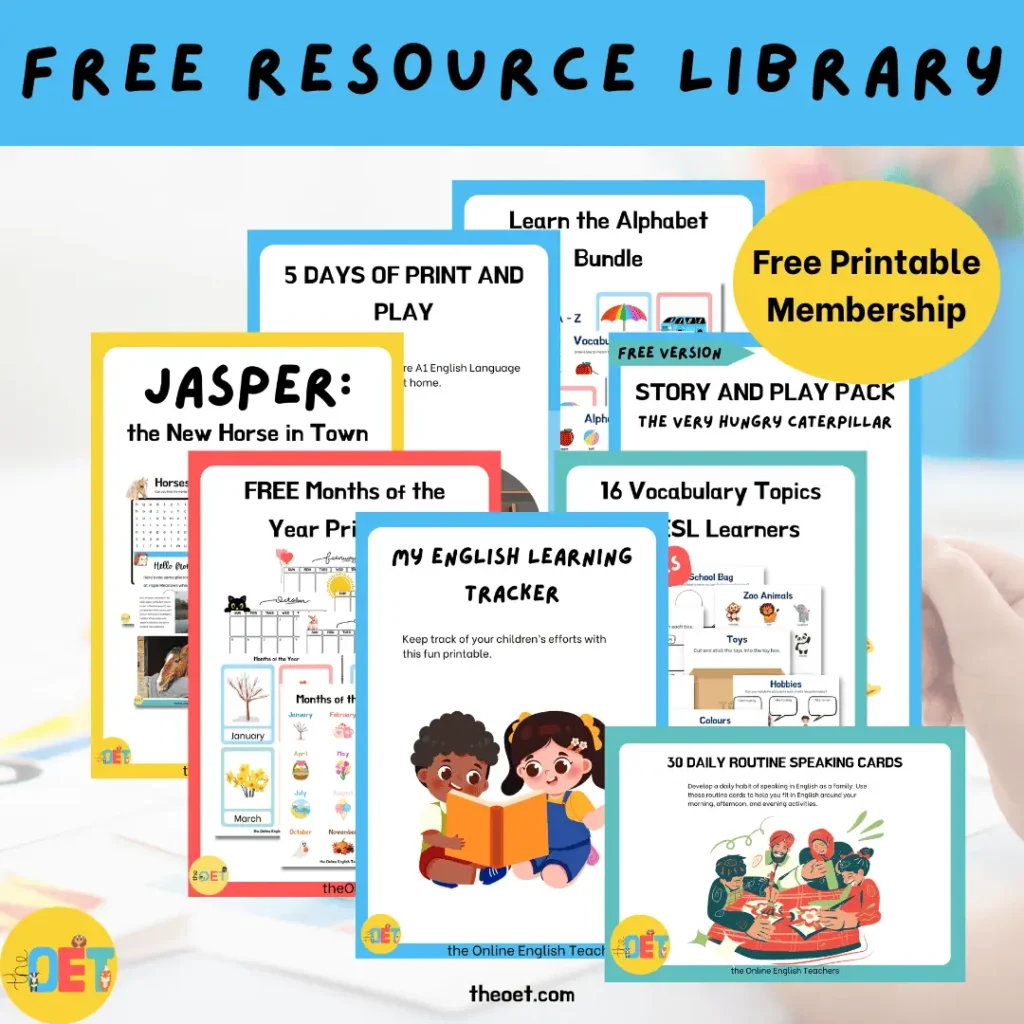
Join the FREE Resource Library
Looking for FREE quality printables, templates, and guides to help you teach your kids ESL at home?
Join theOET’s FREE Membership and gain access to 10s of resources designed by a qualified teacher to help your family learn English at home.
New resources are added every month. Save time, money, and stress with pre-made educational printables and guides.
Storytime is a small activity in the grand scheme of learning English, but it can have a huge positive effect. Storytelling builds confidence in kids by:
- offering a familiar activity,
- extendable activities,
- Demonstrating clear examples of vocabulary and grammar,
All while offering an activity the whole family can get involved with, no matter the age range.
Putting everything together from this post, here’s a sample week’s worth of activities focusing on using storytelling to build your children’s confidence as they learn English:
- Day 1: Picture walk and echo two lines from a short book.
- Day 2: Write a 5-sentence story about a school moment.
- Day 3: Puppet chat with I can… lines and one new verb.
- Day 4: SWBST retell of a favourite tale in 60 seconds.
- Day 5: Role-play a shop, practise five useful phrases.
- Day 6: Record a 30-second story diary on your phone.
- Day 7: Family storytelling night, stickers for brave tries.
Pick one story and start today. Your children will feel braver, and they will appreciate you participating alongside them. You have everything you need at home; you just need to take the first step to incorporate storytelling into your everyday routine.
Related Posts
- The Power of Storytelling: How Stories Can Enhance English Language Learning
- 15 Interactive Storytelling Games for Children Learning the English Language
- Engaging Your Child’s Imagination: Story-Based English Learning Activities
- Creating a Storytelling Routine: Incorporating English into Your Family’s Daily Life
- Top 11 Fable Stories for Kids to Build English Language Skills

