
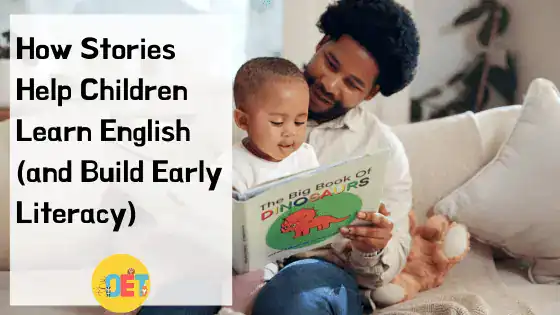
If you’ve been told that children learn English best through worksheets, spelling lists, and grammar drills, you’re not alone. That approach can set high expectations too early, which often turns learning into pressure rather than progress. When your children feel pushed to memorise, they may learn “bits” of English, but they don’t always understand how the language works in real life.
Stories can change that. They give meaning, emotion, and context, which is exactly what young children need when they’re learning English as a second language and building early literacy skills. Children actually learn best when their learning is taught in a meaningful way.
Why Stories Beat Textbooks for Learning English
Textbooks and worksheets often look like “proper learning”, but they can quietly create problems for young children. When the focus is on getting answers right, your children can start to worry about making mistakes. That worry can lead to silence, frustration, or refusing to join in, especially for children who are still building confidence in English.
Stories work differently because they don’t ask your children to perform. Instead, they invite your children into a world where language has a purpose. A character feels hungry, gets lost, makes a friend, or solves a problem. Suddenly, English isn’t a list of words to remember, it’s a tool your children use to understand what’s happening.
Early literacy is more than simply reading words on a page. It’s about understanding, listening, speaking, and feeling confident enough to try.

Unlimited Access to Educational Story and Play Activity Packs for Your Children (Pre A1-A1)
Join the Print and Play Club and gain access to all theOET’s educational Story and Play Activity Packs. Each pack offers 7 days worth of printable activities your children can complete surrounding a popular children’s book. From core ESL skills to learning through play and games, each pack focuses on helping your children learn English through stories and play.
How Children Naturally Learn Language
Think back to how your children learned their first language. You didn’t sit them down at two years old with a textbook and a vocabulary test. You spoke, played, repeated yourself, and shared moments together. Your children learned because you were a role model and used language in real-life situations with them.
At home, language learning often looks like play. You might act out “going to the shop” with toy food, pretend to be doctors with a teddy, or chat about what you see on a walk. Bedtime stories matter too, because you naturally point to pictures, name what you see, and show your children how books work.
This is the kind of learning that improves retention, because it fits the way children grow.
Here are the building blocks children often learn through:
- Stories
- Play
- Repetition
- Emotion
- Real-life, play-based scenarios
Play-based learning wins because it feels safe. Your children can copy you, try new words, and practise the same phrases without it feeling like “practice”. When they hear the same sentence pattern again in a story, or repeat a line while acting it out, they’re learning grammar and vocabulary without needing a drill.
In other words, you’re not forcing your children to learn, you are letting it build naturally.

What Stories Offer Your Children
Stories offer far more than just entertainment. With one book, you can support vocabulary, sentence patterns, listening skills, memory, and even social and emotional understanding. That’s a lot of learning from a simple routine.
When you use stories, your children learn English in context, with less pressure to translate or “get it right”.
Vocabulary and Sentence Patterns
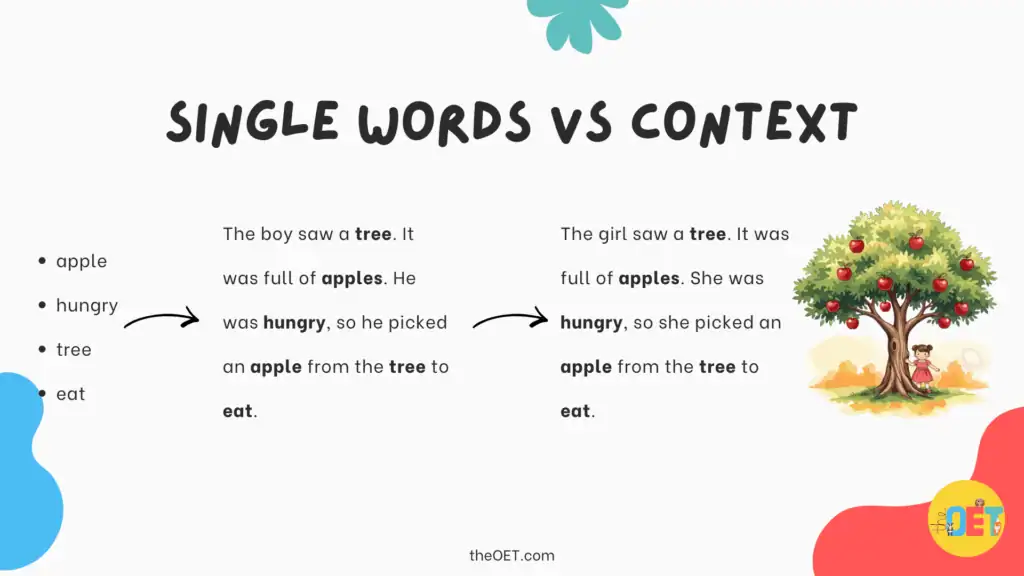
A word list might teach “apple, hungry, tree, eat”. Your children can repeat those words, but they still have to work out how the words connect.
Now compare that to a story:
“The boy saw a tree. It was full of apples. He was hungry, so he picked an apple from the tree to eat.”
In a story, your children hear how English actually sounds. They start to notice sentence patterns, not just single words. They can also use context clues to understand meaning without translating every word.
Pictures make this even easier. When an illustration shows the tree and the apples, your children gain a visual “anchor” for the new vocabulary, which helps understanding and memory.
Imagination, Prediction, Memory, and Emotional Skills
Stories also build skills that worksheets rarely cover.
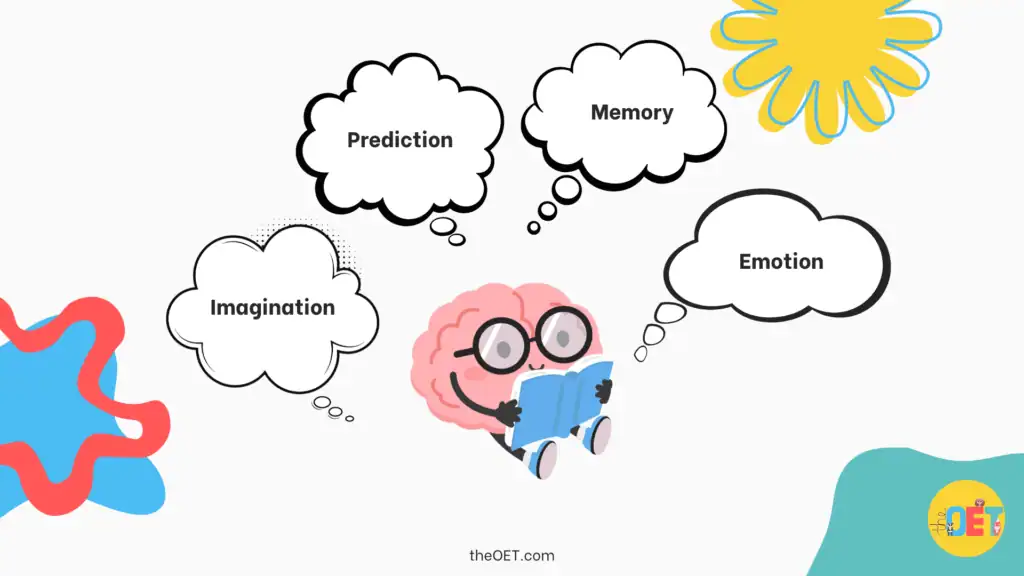
Imagination and creativity grow because stories give your children ideas. After a book, they might invent a new character, draw a new scene, or act out a moment they loved.
Prediction and comprehension develop when you pause and ask what might happen next. Your children start to think ahead, which strengthens understanding.
Memory and repetition improve because children often want the same story again and again. That repetition becomes a natural review of vocabulary and concepts.
Emotional awareness builds because stories talk about feelings and relationships. Your children learn words for emotions, and they start to make sense of the world through characters and situations.
Just as importantly, stories help your children stay calm while learning. “Stories provide a calm learning space.” When your children feel relaxed, they take in more language and try more often.
A Simple Weekly Story Routine
Reading a story once is helpful, but you’ll get more progress when you stretch one story across a whole week. That routine also helps your children feel secure, because they know what to expect each day.
Instead of teaching vocabulary on Monday, phonics on Tuesday, and writing on Wednesday as separate “subjects”, you keep everything connected to the same book. The story becomes your theme, and the activities stay playful and practical.
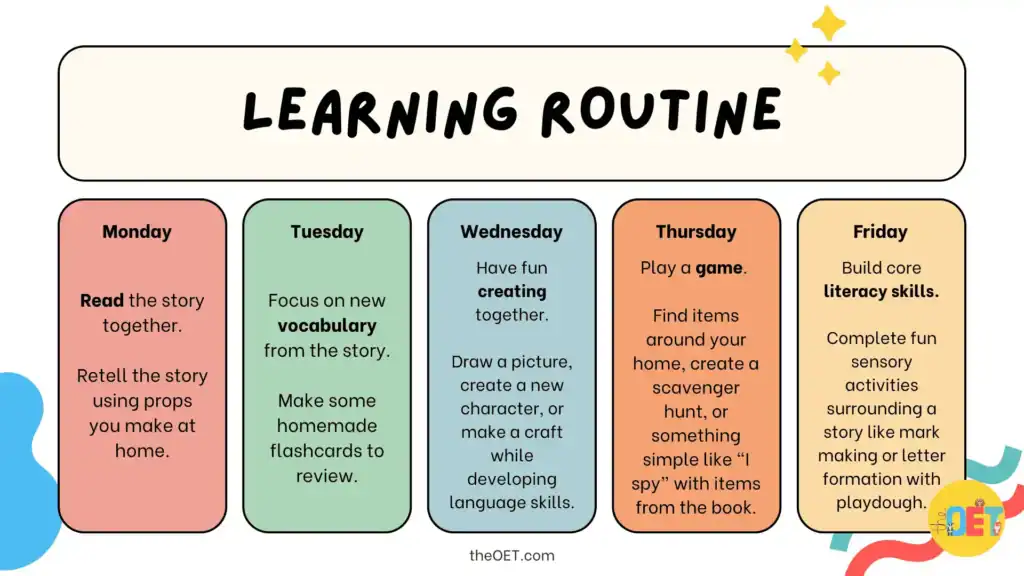
Here’s what that weekly rhythm can look like in a simple snapshot:
| Day | Focus | What you do with the story |
|---|---|---|
| Monday | Read and retell | Read together, then retell using props you make at home |
| Tuesday | Vocabulary | Make simple flashcards, then play quick games to review words |
| Wednesday | Creativity | Draw a scene, make a character, or create puppets for retelling |
| Thursday | Games | Play scavenger hunts or I Spy using story words and objects |
| Friday | Early literacy | Try sensory mark-making, letter shapes, or fine-motor activities |
| Weekend | Review | Bring the week together, revisit language, and enjoy the story again |
The takeaway is simple: your children practise the same language in different ways, so it moves from “heard it once” to “I can use it”.
Even better, this routine gives you a plan without making your home feel like a classroom. You’re still reading a book, playing, making things, and chatting. English happens as part of what you’re already doing.
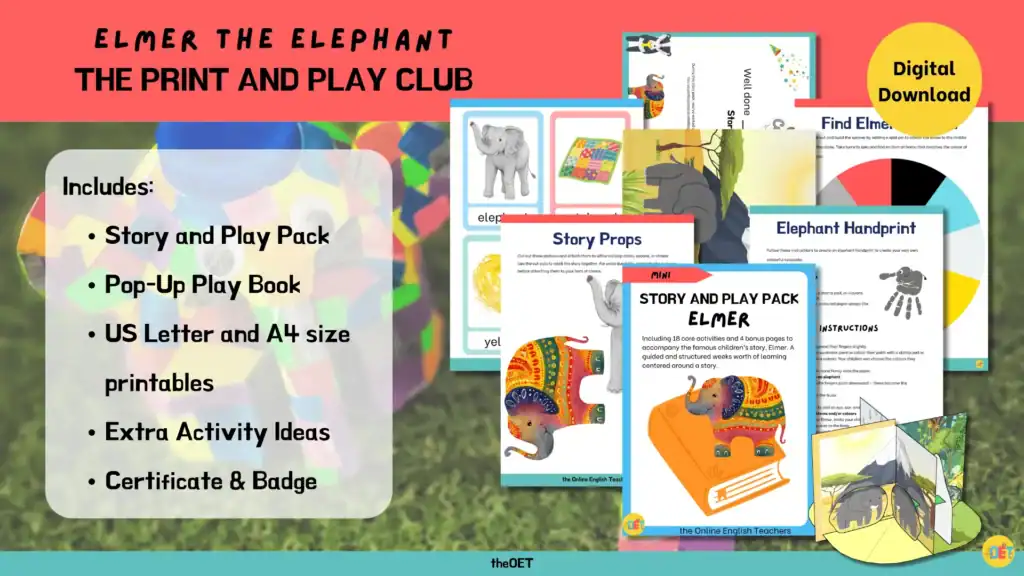
A Real Example: A Full Week with the Elmer Story and Play Activity Pack
It helps to picture this routine with a real book. Let’s provide an example using activities from the Elmer Story and Play Activity Pack (Elmer is the patchwork elephant story, full of colour, friendship, and feelings).
You can follow a simple day-by-day flow, while still keeping it fun and child-led.
Monday: read Elmer, then retell it together. After reading, you use printable story props and playmats to act out the story. As you move the pieces, you naturally repeat key words and phrases. Retelling also helps your children practise speaking without the pressure of “making up” sentences from scratch.
Tuesday: focus on story vocabulary with games. You print and cut out flashcards, then play something familiar like pairs. You can also use a simple tic-tac-toe style game, where your children need to recognise the right card to place it, aiming to get three in a row.
Wednesday: create a patchwork craft. Elmer suits this perfectly. With a template and instructions, your children design their own patchwork elephant using colours, paint, fingerprints, or even fabric squares. While you create, your children hear useful English again and again (colour words, instructions, and simple descriptions).
Thursday: go on a rainbow walk or colour scavenger hunt. If you can’t get outside, you can do this indoors. Your children use a rainbow walk frame to search for colours around the house. If you can get outdoors, you spot colours in nature too, like a brown fence or a green leaf. This step matters because it connects story language to real life.
Friday: play a roll and cover game to review colours. You roll a dice, then cover or colour the matching part on the elephant. It’s quick, repeatable, and it keeps the vocabulary active.
Saturday: review by building sentences. Your children cut out words and stick them in order to build a sentence. After a week of colours and elephants, sentence building feels more possible, because the vocabulary is already familiar.
Sunday: finish with an elephant handprint craft. It sounds simple, but it’s full of language. You talk through the materials, give instructions, and chat about what you’re making. Your children practise listening, understanding, and following steps in English, while enjoying the activity.
Across the week, you support listening, comprehension, speaking confidence, and early literacy skills, but it still feels like stories and play, not a formal lesson.
You Don’t Need Perfect English to Teach Through Stories
It’s easy to think you need teaching qualifications or perfect English to help your children learn well. But the truth is, you don’t.
Your role is to be a role model and a facilitator. You show your children how to hold a book, look at pictures, talk about what’s happening, and enjoy story time together. That’s enough to build strong foundations.
You can also remind yourself that story time doesn’t end when the book closes. One story can lead to days of language-rich play. To keep things simple and avoid overwhelm, stick to one book at a time and expand gently.
Here are a few story follow-up ideas you can keep in your back pocket:
- Role-play a favourite scene using toys
- Design a new character and describe them
- Create a new ending and act it out together
When learning feels relaxed, your children take more risks with language. That’s often when the biggest jumps happen.

Ready-Made Story and Play Resources For Your Family
If you like the weekly routine idea but don’t want to plan activities from scratch, you can get support through the Online English Teachers.
The Print and Play Club includes printable story and play activity packs for popular children’s books, with a 7-day activity plan you can follow at home. You can explore membership details on the Print and Play Club enrolment page.
Unlimited Access to Educational Story and Play Activity Packs for Your Children (Pre A1-A1)
Join the Print and Play Club and gain access to all theOET’s educational Story and Play Activity Packs. Each pack offers 7 days worth of printable activities your children can complete surrounding a popular children’s book. From core ESL skills to learning through play and games, each pack focuses on helping your children learn English through stories and play.
If you’d rather start small, you can also use the free resource library of introductory printables and guides to try the approach at home.
Once you understand how stories help children learn English, it’s hard to see story time as “just reading”. One book can support vocabulary, confidence, early literacy, and emotional language, especially when you use it across a week in playful ways.
Pick one story your children already love, then repeat it, talk about it, and play with it. Keep the pressure low, keep the routine simple, and let the learning build naturally. What story will you start with this week?
Related Posts
- Engaging Your Child’s Imagination: Story-Based English Learning Activities
- Creating a Storytelling Routine: Incorporating English into Your Family’s Daily Life
- Teaching ESL Through Play: Research-Backed Strategies for Families
- How to Use Bedtime Stories to Teach English at Home
- Role Play Ideas for Teaching English at Home (Fun, Simple & Family-Friendly)
Hi, I’m Catherine
I help children learn English at home through stories and play with affordable and accessible resources. With over 10 years of experience educating children and over 5000 online ESL classes, I’ve learnt what methods work to keep children engaged and motivated to learn.
I look forward to helping your children develop their English skills!


