
Do your children mix up March and May, or forget what comes after September? You’re not alone. Learning months of the year vocabulary is one of those early English skills that sounds simple, but it takes time, repetition, and a bit of fun to make it stick.
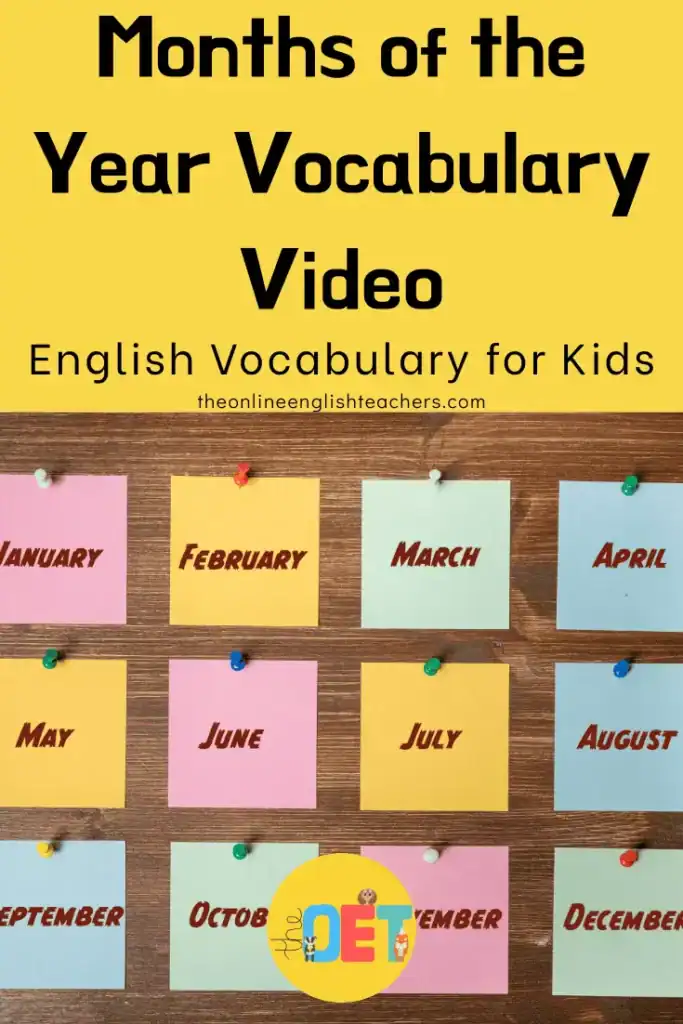
This family-friendly video from the Online English Teachers helps your children learn the names of all 12 months, practise saying them clearly, and link each month to a memorable seasonal idea (like fireworks, ice cream, crunchy leaves, or baking cookies). You can watch together, copy the words out loud, then use the ideas below to keep practising during the week.
Why Months of the Year Vocabulary Matters for ESL Learners
Months come up all the time in real life. Once your children know them, everyday English gets easier.
You’ll hear months when you:
- talk about birthdays and holidays
- plan trips, school dates, and appointments
- chat about seasons and weather
- practise writing the date (day, month, year)
For young ESL learners, months also build confidence because they are a clear set of 12 words. There’s a beginning and an end, and you can repeat them in order like a song. That feeling of “I know this!” matters.
Repetition helps your children remember
The video uses a simple, effective routine: each month is said twice (for example, “January. January.”). That gives your children a safe chance to listen first, then speak.
A simple way to use this at home is the “listen, then echo” method:
- You listen once together.
- Your children echo the word back.
- You repeat it one more time, slowly, with clear mouth shapes.
If your children are shy, you can join in too. Hearing you try is often all they need.
Fun scenes make the words easier to recall
The video also connects each month to a clear image or event, like fireworks in January or Halloween in October. That’s helpful because your children are not just memorising a list. They’re building a little mental picture, and pictures are easier to hold onto than abstract words.
You can make it even more memorable by adding actions at home (more on that later).

Explore the FREE Resource Library
Fun, educational activities for children aged 3–8 completely free!
Discover a growing collection of printable games, vocabulary activities, crafts, and themed resources designed to help children build language and literacy skills through stories, play, and creativity.
Spend less time searching for activities and more time learning, playing, and creating together.
Learn All 12 Months with Easy Repetition
Before you move on to extra activities, it helps to get comfortable with the full set of month names.
Here are the 12 months, in order:
January, February, March, April, May, June, July, August, September, October, November, December.
Chant the months together (out loud)
Reading silently won’t give the same result. Months are speaking practice as much as vocabulary practice, so say them as a chant. If you’ve got more than one child, let them take turns leading.
Try this call-and-repeat style, matching the video’s rhythm:
January. January.
February. February.
March. March.
April. April.
May. May.
June. June.
July. July.
August. August.
September. September.
October. October.
November. November.
December. December.
Keep it relaxed and fun. If your children stumble, you can smile and go back to the last word they knew.
A quick “loop” practice that feels like a game
The video also cycles through the months again, which is useful because the second run-through often sounds clearer than the first.
At home, you can copy that idea with a simple routine:
- First round: say the months slowly.
- Second round: say them a little faster.
- Third round: whisper them.
- Fourth round: say them like a robot.
You’re still practising the same words, but it doesn’t feel like drill.
Month-by-month Memory Cues (the fun part)
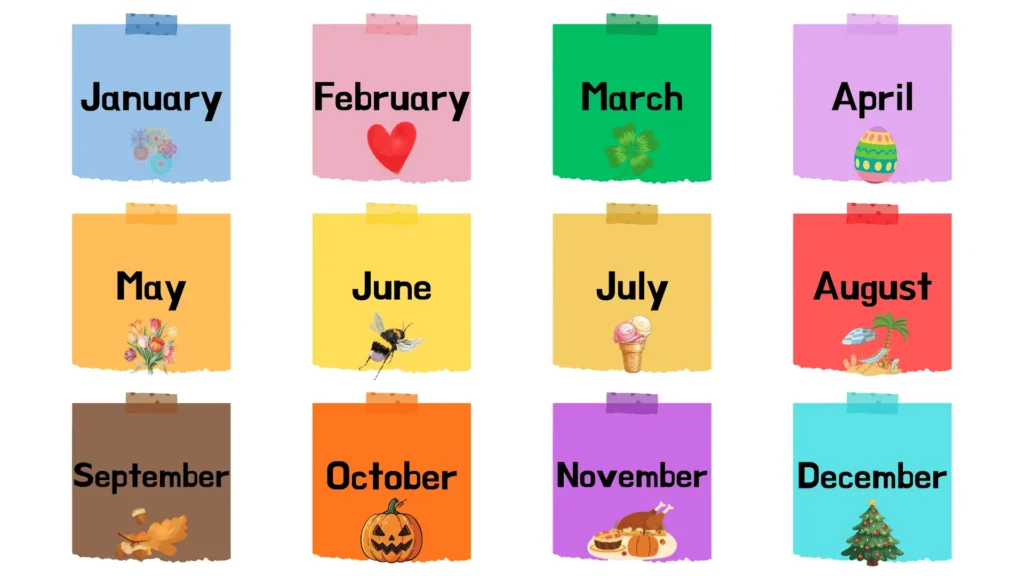
Linking each month to a clear cue helps your children answer questions like “What month is it?” without panic. The video uses one cue for each month, and you can use those cues as prompts at home.
January to June highlights
- January: lots of fireworks for New Year
- February: Valentine’s
- March: St. Patrick’s Day
- April: an Easter egg hunt
- May: lots of flowers
- June: a bee on a flower
A helpful home habit is “say it, point it, act it”. For example, when you say January, you can mime fireworks in the sky. For May, you can pretend to smell a flower.
July to December highlights
- July: eating ice cream
- August: going to the beach
- September: lots of crunchy leaves
- October: Halloween
- November: many people celebrate Thanksgiving
- December: baking Christmas cookies
If you live somewhere that doesn’t celebrate Thanksgiving, you can still use the cue as a memory hook. You’re not teaching a full festival lesson here, you’re giving meaning to the word “November” while teaching them about other cultures and celebrations around the world.

A quick reference table you can stick on the fridge
If your children like to check their answers (and many do), a simple chart helps.
| Month | Cue from the video |
|---|---|
| January | Fireworks for New Year |
| February | Valentine’s |
| March | St. Patrick’s Day |
| April | Easter egg hunt |
| May | Lots of flowers |
| June | A bee on a flower |
| July | Ice cream |
| August | Beach |
| September | Crunchy leaves |
| October | Halloween |
| November | Thanksgiving |
| December | Bake Christmas cookies |
You can also invite your children to draw their own picture next to each month. A messy drawing that they made themselves often beats a perfect printed image.
Test Your Children: “What Month Is It?”
The video includes a guessing game where your children look at a clue, then choose the month. This is great practice because it moves from simple repeating to real understanding.
You can play the same game at home using spoken clues. Keep your voice playful, and pause long enough for your children to think.
Clue-based guessing game (with answers)
- You see fireworks for New Year. It must be January.
- You’re having Valentine’s Day. That means February.
- It’s St. Patrick’s Day. It’s March.
- You’re going on an Easter egg hunt. It’s April.
- There are lots of flowers to see. It’s May.
- There’s a bee on the flower. That must mean June.
- You can eat ice cream. It’s July.
- You can go to the beach, and it’s hot. It’s August.
- There are lots of crunchy, colourful leaves. It’s September.
- It’s Halloween. Halloween is in October.
- It’s Thanksgiving. That means it’s November.
- You’re baking Christmas cookies. That’s December.
If your children guess wrong, treat it as useful information, not a mistake. Just repeat the clue and say the month again together.

Make the quiz work for mixed ages
If you’ve got children at different levels, you can keep everyone involved with small tweaks:
- For beginners: give two choices, “Is it May or June?”
- For confident learners: ask for a full sentence, “It’s May.”
- For siblings together: one child gives the clue, the other guesses.
That way, everyone practises speaking, not just listening.
Learn The Months In Order (First to Last)
Saying months in order is a different skill from recognising them. The video practises this by asking questions like “What’s the first month?” and “What comes after May?”
You can copy that at home in short bursts, even while you’re making tea.
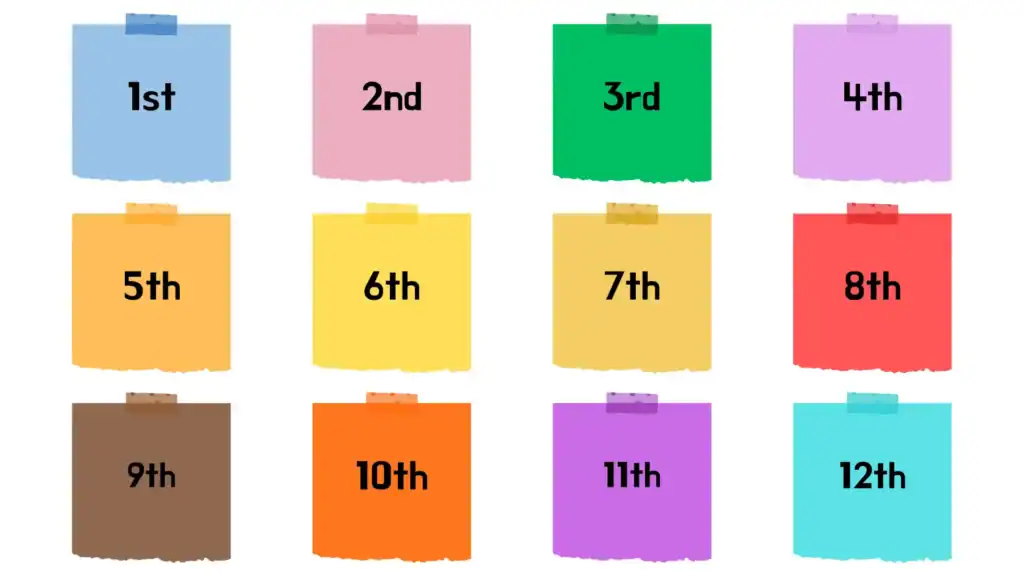
The 12 months in order (with ordinal numbers)
1st: January
2nd: February
3rd: March
4th: April
5th: May
6th: June
7th: July
8th: August
9th: September
10th: October
11th: November
12th: December
If your children find ordinals tricky (1st, 2nd, 3rd), you can still practise the order without them. Add ordinals later once the month names feel easy.
Quick “what comes after?” drill
This style of question is simple, but it builds strong recall.
| Question | Answer |
|---|---|
| What comes after May? | June |
| What comes after June? | July |
| What comes after August? | September |
| What comes after September? | October |
| What’s the last month? | December |
Keep it short. One minute of practice done often beats a long session once a week.
Easy Follow-on Activities for Families (No Fancy Prep)
Once your children have watched the video a few times, they’ll learn faster if you connect the months to your real home life. These activities are simple, and you can do them in little moments.
Create a “month of the day” routine
Pick one moment each day, breakfast works well, and ask one question:
“What month is it?”
Then help your children answer in a full sentence: “It’s December.”
If your children are ready, add: “In December, we bake cookies.” It mirrors the video and gives extra speaking practice.
Make a calendar on the wall with pictures
Choose 12 pieces of paper (or one big sheet) and write one month on each. Then add one small drawing linked to the video cue (fireworks, heart, shamrock, egg, flower, bee, ice cream, beach, leaf, pumpkin, Thanksgiving meal, cookies).
If your children enjoy crafts, you can let them:
- colour the pictures
- cut out magazine images
- add stickers
- tape the months in order on a wall or door
This turns a vocabulary list into something your children can touch and revisit.
Play “shuffle and fix”
Write each month on a small card. Mix them up, then challenge your children to put them back in order.
To keep it friendly, start with a smaller set:
- first: January to April
- next: add May and June
- then: build up to all 12
When your children can fix the order, ask one extra question: “What comes before June?” That one small change gives a big learning boost.
Use real dates your children care about
Months become meaningful when they connect to your family.
Try sentences like:
- “Your birthday is in May.”
- “School starts in September.”
- “We go to the beach in August.”
- “We bake cookies in December.”
You’re still using the same months of the year vocabulary, but now it’s personal, which helps it stick.
Free printables to support practice at home
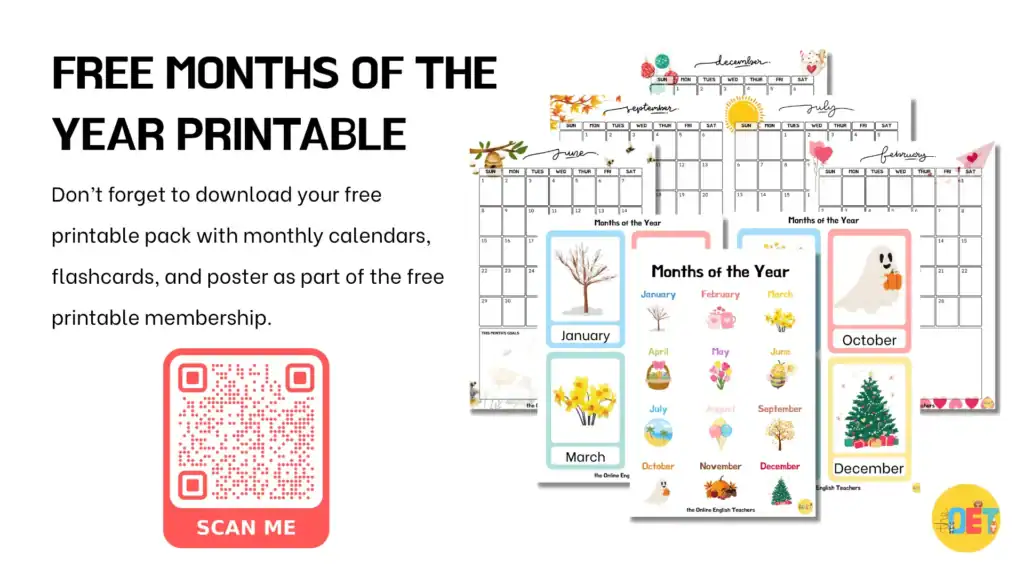
If your children learn well with visuals, the video mentions a free printable pack you can use at home. It includes a poster, flashcards, and a calendar themed around the months.
You can access it through the Online English Teachers’ Free Resource Library for educational printables.
A simple way to use the printables is to keep the poster up for daily pointing, then use the flashcards for quick games (matching, ordering, or “hide one card and guess what’s missing”).
You don’t need a long lesson to make progress. Watch the video again, chant along, and practise one small activity each day. Your children will start to say the months more clearly, and they’ll answer “What month is it?” with less hesitation.
Most importantly, keep the tone upbeat. Well done counts for a lot, especially with young ESL learners.
Related Posts
- How to Help Your Children with Poor Vocabulary
- Winter Weather Vocabulary for Kids: Fun ESL Learning at Home
- Autumn Vocabulary for Kids: Fun ESL Words and Activities at Home
- How to Use Flashcards for Families Learning ESL
- 20 Fun and Educational Word Games for Kids Learning English
Hi, I’m Catherine
I help children learn English at home through stories and play with affordable and accessible resources. With over 10 years of experience educating children and over 5000 online ESL classes, I’ve learnt what methods work to keep children engaged and motivated to learn.
I look forward to helping your children develop their English skills!


